
*** HISTORY ***
Mongolia's history is
extremely long; it spans over 5,000. "The Mongols has little inclination to
ally with other nomadic peoples of northern Asia and, until the end of the
12th century, the Mongols were little more than a loose confederation of
rival clans, It was in the late 12th century that a 20-year-old Mongol named
Temujin emerged and managed to unite most of the Mongol tribes. In 1189 he
was given the honorary name of Chinggis Khan, meaning 'universal king'. No
Mongolian leader before or since has united the Mongolians so effectively."
Manchu controlled Mongolia from the
year 1691 to 1911. Thanks to the fall of the Manchu dynasty that controlled
stopped. A group of Mongol princes "proclaimed" the living Buddha of Urga to
be ruler. "Mongolians have always taken wholeheartedly to Tibetan Buddhism
and the links between Mongolia and Tibet are old and deep." In 1921 there
were 110,000 lamas or monks in Mongolia living in 700 monasteries. In the
1930s thousands of monks were arrested. Some believed that by the year 1939
3% of Mongolia's population, at the time, was executed or out of 27,000;
17,000 were monks.
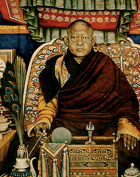 Bogd
Khan (1869-1924)
Bogd
Khan (1869-1924)In the year 1990 the freedom of
religion returned. Since then a revival of Buddhism and other religions has
occurred. Mongolia won its independence in 1911. In 1921 the Mongolian
People's Revolutionary Party government started. "When the last living
Buddha died in 1924( "with the rise of Tibetan Buddhism in the 16th century,
a living Buddha would be named"), the Mongolian People's Republic was
established." It took 22 years for China to recognize this. All subsequent
Mongolian texts were written in script until Stalin forcibly replaced it
with Russian Cyrillic in the 1940s. The text was written in scripts named
SECRET HISTORY scripts. Since 1944 the Russian Cyrillic alphabet has been
used to write Mongolian.
A new constitution came into force in 1960, and Mongolia was admitted to the United Nations in 1961. Mongolia traditionally supported the Soviet Union. In January 1992 the president of Mongolia, Ponsalmaagiyh Ochirbat institutes a new constitution. "In 1993, Birus Yeltsin, Russia's president and Ochirbar signed a new treaty." Also Ochirbat was reelected in 1993.
In the 1980s Mongolia fell in control of Jambyn Batmonkh, decentralize heartened by the Soviet reforms under Mikhail Gorbachev. "By the late 1980s, relations with China even started to thaw and full diplomatic relations were established in1989. "In March 1990, large pro-democracy protests erupted in the square in front of the parliament building in Ulaan Baatar and hunger strikes were held." Also lots of things happened at a rapid paste around that same month. Some of which are: Batmonkh lost power; new political parties sprang up; and hunger strikes and protests continued. In May Mongolia was awarded from the government to have multiparty election in June 1990. The communists won the elections. In the first half of the year 1996 Mongolia was "beset" by wild fires that raged for more than three months and lost 41,000 sq mi (106,000 sq km) of forest and rangeland. In the year 1997 Ochirbat lost the election because of the economy. In the year 2000 the elections resulted in nearly a total win for the MPRP.
*** Timeline ***
Prehistory
500 000 BC Human presence in Mongolia
4000 BC to 2000 BC Bronze Age
2000 av. JC Development of herding in Mongolia
700 to 500 av. JC Transition to the beginning of the Iron Age
400 av. JC Construction of the Great Wall of China, who was used as a
frontier between China and Hunnu
Hunnu and next states
209 BC Modun Shanyui built first state, which named Hunnu
200 BC Xionghu (Hunnu) Mongolian Empire reaches The Yellow river
AD 1-100 Xionghu expelled from China
156 AD Xianbei (Sumbe) defeat Hunnu state and became most powerful in
Central Asia
300 AD Toba
317 Xianbei conquer northern China
386 to 533 Period of Northern Wei Dynasty, established by the Toba in
northern China mid-8th century
Possible early Mongol links with Tibetan Buddhism
840 Kyrghiz defeat ruling Uighurs
916 to 1125 Beginning of Kitan period, established over eastern Mongolia,
Manchuria, and northern China
1122 The ruling Kitan defeated by Chinese
Great Mongolian Empire
1162 The child Temujin, later to become Chinggis Khan, is born
1189 Temujin takes the title of Chinggis Khan (Universal King)
1189 to 1205 Chinggis Khan unites Mongols
1206 Chinggis Khan proclaims himself ruler Of the Mongol Empire
1211 Chinggis Khan launches attacks to China
1215 Khanbalik (Beijing) falls to the Mongols
1227 Chinggis Khan dies
1129 Ogedei Khan, Chinggis’s third and favorite son, proclaimed the second
khan
1231 Korea invaded
1235 Karakorum built by Ogedei Khan
Marco Polo arrives in Karakorum
1236 to 1240 Campaigns against Russia by Bat Khan, little son of Chinggis
Khan, with his Golden Horde
1237 Start of campaigns to Russia and Europe (battle of the river Kalka)
that was halted at Vienna with death of Ogedei
1240 to 1480 Suzerainty over Russia established by Golden Horde
Conquest of Song China
1241 Dead of Ogedei
1241 to 1242 Poland and Hungary invaded
1246 Guyuk, son of Ogedei, becomes Khan, he dies that year
1251 Mongke (Monkh) from another wing of the family becomes Khan
1251 Iran invaded
1259 Dead of Mongke, his brother Kublai becomes Khan
1260 Mongols defeated by Egyptian Mamluks
1261 Khubilai becomes great khan
1264 Capital moved from Karakorum to Khanbalik (Beijing)
1274 and 1281 Unsuccessful attempts at invasion of Japan
1275 Marco Polo arrives in China
1276 Hangzhou, capital of Song China falls to the Mongols
1279 Kublai Khan, Chinggis Khan’s grandson, completes the conquest of China
1294 Kublai Khan dies
1299 Mongol invasion of Syria
1368 Mongols driven out of China, Yuan Dynasty destroyed
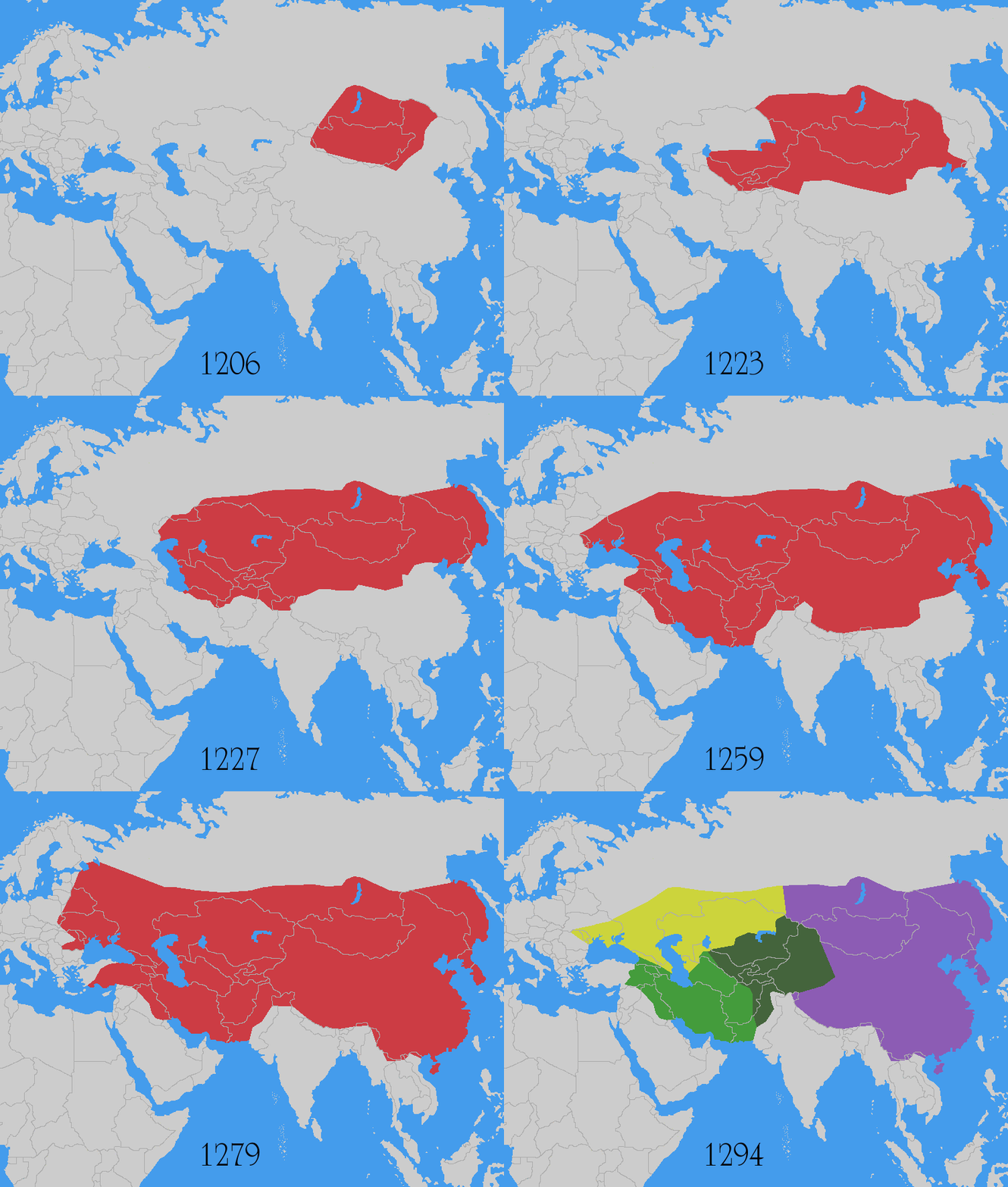
Fall Mongolian Empire and subjugation by Manchu
1400-1454 Civil war in Mongolia
1578 Altan Khan converts to Buddhism and gives the title Dalai Lama to Sonam
Gyatso
1586 Erdene Zuu, Mongolia’s first monastery, is started
1641 Zanabazar proclaimed leader of Buddhists in Mongolia
1911 Independence from China
1915 Russia, China and Mongolia sign agreement to grant independence to
Mongolia
1919 Chinese invade Mongolia again
Independence, socialism years and democracy
1921 Chinese defeated, Mongolia’s independence proclaimed by Sukhbaatar
1924 Bogd Khan (Holy King) dies, the Mongolian People’s Republic declared by
the communists
1939 Russian and Mongolian troops fight Japan in eastern Mongolia
1990 Pro-democracy protests held, communists win multi-party election
1992 New constitution announced, communists win another election
1996 Democratic Coalition unexpectedly thrashes communists in an election
2000 Communists unexpectedly thrash the Democrats in the election
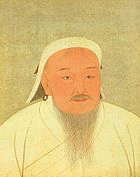 Chinggis
Khan (1162-1227)
Chinggis
Khan (1162-1227)