Note:
The current national anthem was written in 1950. The music was composed by
Bilegiin Damdinsüren (1919-1991) and Luvsanjamts Murjorj (1915-1996) and the
words were written by Tsendiin Damdinsüren (1908-1986). The anthem was
changed slightly in 1961 to include references to communism and the
Communist Party, however the original words were restored in the early
1990's following the election of a democratic government. This anthem
replaced the Internationale - a communist workers song adopted following the
proclamation of the Mongolian Peoples Republic in 1924. Damdinsüren, a
native of Dornod Aimag, was a giant of modern Mongolian literature, whose
influence on modern writing is second only to that of Natsagdorj. He spent
his formative years studying abroad in Leningrad (1933-38) where he became
fluent in Russian, worked as a translator, and produced a diverse body of
work including poetry, fiction, translation, history and literary criticism.
In 1947 he published a beautiful translation of the Secret History in modern
Mongolian, and was a three times winner of the prestigious State Prize. He
was also instrumental in the introduction of the Cyrillic alphabet in the
1940s.
Flag
of Mongolia
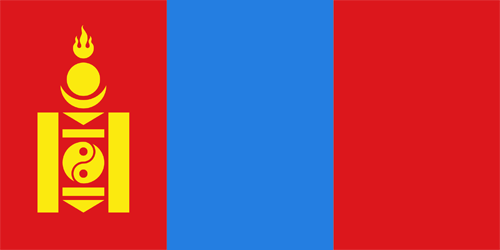 The
flag of Mongolia is red, blue and red, with the Golden Soyombo placed on the
right side. Soyombo is the symbol of the freedom and independence of the
Mongolian people. The Soyombo appeared on the flag at different times in
Mongolian history. In the 17th century and again from 1911 to 1912 it was
used. And in 1921 the Mongolians fighting the Manchu emperor put it on their
flag. In 1924 during the first conference of the new Republic of Mongolia
the Soyombo was made part of the national flag.
The
flag of Mongolia is red, blue and red, with the Golden Soyombo placed on the
right side. Soyombo is the symbol of the freedom and independence of the
Mongolian people. The Soyombo appeared on the flag at different times in
Mongolian history. In the 17th century and again from 1911 to 1912 it was
used. And in 1921 the Mongolians fighting the Manchu emperor put it on their
flag. In 1924 during the first conference of the new Republic of Mongolia
the Soyombo was made part of the national flag.
Description:
The flag of Mongolia consists of three equal sized vertical stripes - the
left and right stripes are red and the middle one is blue. On the left hand
side of the Mongolian flag, in the red stripe is the country's national
emblem which is a 'soyombo', a columnar arrangement of abstract and
geometric representation for fire, sun, moon, earth, water, and the yin-yang
symbol.
Blue is a traditional Mongolian color and it represents the sky.
The red stripes initially represented Mongolia's socialist beliefs, but a
modern interpretation means liberty and progress.
Flame: The upper part of the Soyombo is a flame. The three branches of the
flame stand for the past, present and future and the connection between
three. Fire is seen as a symbol of prosperity and success.
Sun and moon: These two ancient symbols of Mongolia represent the sky.
Mongolians respect and pray for the eternal blue sky.
The two triangles: they symbolize the spear and arrow. They are both pointed
down to symbolize the defeat of the enemy.
The two rectangles: They stabilize the round figure in between and to make
it upright.
Round is supposed to contain an unstable spirit. The rectangular shape
represents justice and honesty and symbolizes the will of the Mongolian
people to give their potential to the nation.
2 The fish: The round form looks very much like the ying yang symbol. In
Mongolia it stands for two fish. Fish are supposed to look after the country
as the fish never close their eyes. Fish symbolize reproduction as well. The
two upright rectangles: Their image is to express safety and strength.
This is about the Soyombo that is on the flag.
However, the Soyombo alphabet was created in 1686 by the famous Mongolian
monk and scholar Zanabazar.
Though the script has a unique appearance it failed to establish itself as a
script for everyday use. Today it survives in the form of inscriptions on
prayer mills and temples.
A variation of the opening symbol of the Soyombo script (a symbol which
appears before the letter A) is in wide use today. It became the national
symbol of Mongolia and as such it can be found on money, official documents,
official stamps and the like. Members of parliament, members of government
and most state officials have the Soyombo symbol on their name cards. The
exact proportions of the Soyombo symbol were defined in the Constitution of
1992.
Mongolia's Politics
Mongolians
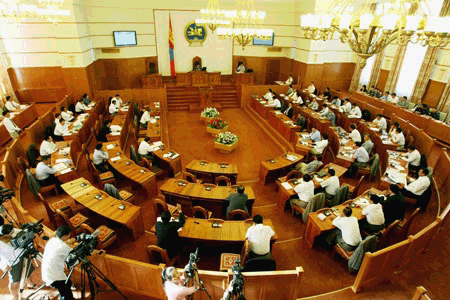
start voting at the age of 18 with the voting process a direct, free
election. A new constitution was adopted in January 1992 that made some
changes in the government, one being the legislative power of Mongolia. The
Great Hural, which consists of 76 members, is the legislative power, with
the delegates being elected every four years like the head of state's term.
The head of state is the president, who is elected to a four-year run in
office.
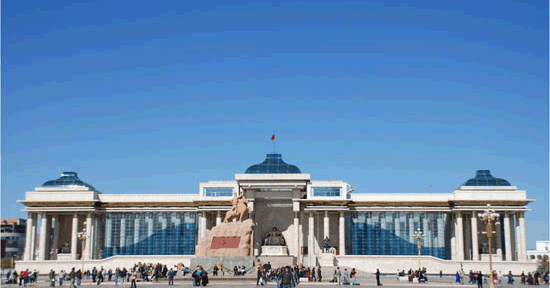
National Parliament Building, Ulaanbaatar, Mongolia.
*** Political developments ***
 Until
1990, the Mongolian Government was modeled on the Soviet system; only the
communist party the MPRP--officially was permitted to function. After some
instability during the first two decades of communist rule in Mongolia,
there was no significant popular unrest until December 1989.
Collectivization of animal husbandry, introduction of agriculture, and the
extension of fixed abodes were all carried out without perceptible popular
opposition.
Until
1990, the Mongolian Government was modeled on the Soviet system; only the
communist party the MPRP--officially was permitted to function. After some
instability during the first two decades of communist rule in Mongolia,
there was no significant popular unrest until December 1989.
Collectivization of animal husbandry, introduction of agriculture, and the
extension of fixed abodes were all carried out without perceptible popular
opposition.
The birth of perestroika in the former Soviet Union and the democracy
movement in Eastern Europe were mirrored in Mongolia. The dramatic shift
toward reform started in early 1990 when the first organized opposition
group, the Mongolian Democratic Union, appeared. In the face of extended
street protests in subzero weather and popular demands for faster reform,
the politburo of the MPRP resigned in March 1990. In May, the constitution
was amended, deleting reference to the MPRP's role as the guiding force in
the country, legalizing opposition parties, creating a standing legislative
body, and establishing the office of president.
Mongolia's first multi-party elections for a People's Great Khural were held
on 29 July 1990. The MPRP won 85% of the seats. The People's Great Khural
first met on 3 September and elected a president (MPRP), vice president (SDP
Social Democrats), Prime Minister (MPRP), and 50 members to the Baga Khural
(small Khural). The vice president also was chairman of the Baga Khural. In
November 1991, the People's Great Khural began discussion on a new
constitution, which entered into force February 12. In addition to
establishing Mongolia as an independent, sovereign republic and guaranteeing
a number of rights and freedoms, the new constitution restructured the
legislative branch of government, creating a unicameral legislature, the
State Great Khural (SGKh).
The 1992 constitution provided that the president would be elected by
popular vote rather than by the legislature as before. In June 1993,
incumbent Punsalmaagiin Ochirbat won the first popular presidential election
running as the candidate of the democratic opposition.