Demographics
 Mongolia's
total population as of July 2007 is estimated by U.S. Census Bureau at
2,951,786 people ranking at around 138th in the world in terms of
population. But the U.S. Department of State Bureau of East Asian and
Pacific Affairs uses the U.N. estimations instead of the U.S. Census
Bureau estimations. United Nations Department of Economic and Social
Affairs Population Division estimates Mongolia's total population (mid.
2007) as 2,629,000 (11% less than the U.S. Census Bureau figure). UN
estimates resemble those made by the Mongolian National Statistical
Office (2,612,900, end of June 2007). Mongolia's population growth rate
is estimated at 1.2% (2007 est.). About 59% of the total population is
under age 30, 27% of whom are under 14. This relatively young and
growing population has placed strains on Mongolia's economy.
Mongolia's
total population as of July 2007 is estimated by U.S. Census Bureau at
2,951,786 people ranking at around 138th in the world in terms of
population. But the U.S. Department of State Bureau of East Asian and
Pacific Affairs uses the U.N. estimations instead of the U.S. Census
Bureau estimations. United Nations Department of Economic and Social
Affairs Population Division estimates Mongolia's total population (mid.
2007) as 2,629,000 (11% less than the U.S. Census Bureau figure). UN
estimates resemble those made by the Mongolian National Statistical
Office (2,612,900, end of June 2007). Mongolia's population growth rate
is estimated at 1.2% (2007 est.). About 59% of the total population is
under age 30, 27% of whom are under 14. This relatively young and
growing population has placed strains on Mongolia's economy.
Since the end of socialism, Mongolia has experienced a decline of total
fertility rate (children per woman) that is steeper than in any other
country in the world, according to recent UN estimations: in 1970-1975,
fertility was estimated to be 7.33 children per woman, but 2005-2010
prospects are 1.87 (4 times less).
Mongolia has become more urbanized. About 40% of the population lives in
Ulaanbaatar, and in 2002 a further 23% lived in Darkhan, Erdenet, the
aimag centers and sum-level permanent settlements. Another share of the
population lives in the sum centers.
Ethnic Mongols account for about 85% of the population and consist of
Khalkha and other groups, all distinguished primarily by dialects of the
Mongol language. The Khalkha make up 90% of the ethnic Mongol
population. The remaining 10% include Buryats, Durbet Mongols and others
in the north and Dariganga Mongols in the east. Turkic peoples (Kazakhs,
Tuvans, and Chantuu (Uzbek) constitute 7% of Mongolia's population, and
the rest are Tungusic peoples, Chinese, and Russians. Most, but not all,
Russians left the country following the withdrawal of economic aid and
collapse of the Soviet Union in 1991.
Languages
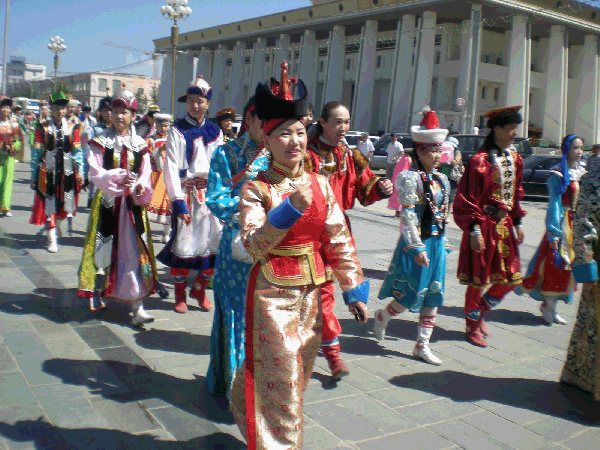 The
official language of Mongolia is Khalkha Mongolian, and is spoken by 90%
of the population. A variety of different dialects of Oirat and Buryat
are spoken across the country, and there are also some speakers of
Mongolic Khamnigan. In the west of the country, Kazakh and Tuvan, both
Turkic languages, are also spoken.
The
official language of Mongolia is Khalkha Mongolian, and is spoken by 90%
of the population. A variety of different dialects of Oirat and Buryat
are spoken across the country, and there are also some speakers of
Mongolic Khamnigan. In the west of the country, Kazakh and Tuvan, both
Turkic languages, are also spoken.
Today, Mongolian is written using the Cyrillic alphabet, although in the
past it was written using the Mongolian script. An official
reintroduction of the old script was planned for 1994, but has not yet
taken place as older generations encountered practical difficulties. The
traditional alphabet is being slowly reintroduced through schools.
The Russian language is the most frequently spoken foreign language in
Mongolia, followed by English, though English has been gradually
replacing Russian as the second language. Korean has gained popularity
as tens of thousands of Mongolians work in South Korea. Interest in
Chinese, as the language of the other neighbouring power, has been
growing. Japanese is also popular among the younger people. A number of
older educated Mongolians speak some German, as they studied in the
former East Germany, while a few speak other languages from the former
Eastern Bloc. Besides that, many younger Mongolians are fluent in the
Western European languages as they study or work in foreign countries
including Germany, France and Italy. Deaf people in Mongolia use
Mongolian Sign Language.
Religion
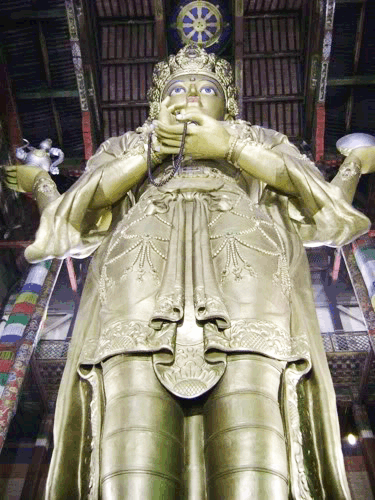 According
to the CIA World Factbook and the U.S. Department of State, 50% of
Mongolia's population follow the Tibetan Buddhism, 40% are listed as
having no religion, 6% are Shamanist, Bahá'í and Christian, and 4% are
Muslim.
According
to the CIA World Factbook and the U.S. Department of State, 50% of
Mongolia's population follow the Tibetan Buddhism, 40% are listed as
having no religion, 6% are Shamanist, Bahá'í and Christian, and 4% are
Muslim.
Various forms of Tengriism and Shamanism have been widely practiced
throughout the history of what is now modern day Mongolia, as such
beliefs were common among nomadic people in Asian history. Such beliefs
gradually gave way to Tibetan Buddhism, but Shamanism has left a mark on
Mongolian religious culture, and continues to be practiced. Amongst the
Mongol elite of the Mongol Empire, Islam was favored over other
religions, as three of the four major khanates adopted Islam.
The fall of communism in 1991 restored the legality of public religious
practice, and Tibetan Buddhism, which had been the predominant religion
in the region before the rise of communism, again rose to become the
most widely practiced religion in Mongolia. The end of religious
repression in the 1990s also allowed for other religions, such as Islam,
Baha'i Faith and Christianity, to spread in the country. According to
the Christian missionary group Barnabas Fund, the number of Christians
grew from just four in 1989 to around 40,000 as of 2008.
Education
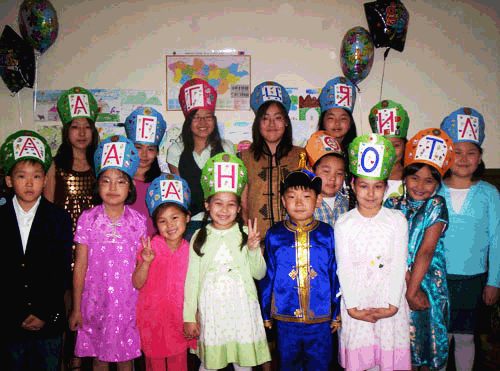 During
the state socialist period, education was one of the areas of
significant achievement in Mongolia. Illiteracy was virtually
eliminated, in part through the use of seasonal boarding schools for
children of nomadic families. Funding to these boarding schools was cut
in the 1990s, contributing to slightly increased illiteracy.
During
the state socialist period, education was one of the areas of
significant achievement in Mongolia. Illiteracy was virtually
eliminated, in part through the use of seasonal boarding schools for
children of nomadic families. Funding to these boarding schools was cut
in the 1990s, contributing to slightly increased illiteracy.
Primary and secondary education formerly lasted 10 years, but was
expanded to 11 years. Since the 2008-2009 school year, new first graders
are using the 12 year system. As such, full transition to the 12-year
system will not happen until the 2019-2020 school year, when the current
third graders graduate.
Mongolian national universities are all spin-offs from the National
University of Mongolia and the Mongolian University of Science and
Technology.
The broad liberalization of the 1990s led to a boom in private
institutions of higher education, although many of these establishments
have difficulty living up to their name of "college" or "university".
Health
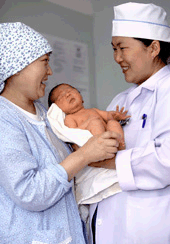 Since
1990, key health indicators like life expectancy and infant and child
mortality have steadily improved, both due to social changes and to
improvement in the health sector. However, serious problems remain,
especially in the countryside.
Since
1990, key health indicators like life expectancy and infant and child
mortality have steadily improved, both due to social changes and to
improvement in the health sector. However, serious problems remain,
especially in the countryside.
Average childbirth (fertility rate) is around 2.22 per woman (2010) and
average life expectancy is 67-68 years. Infant mortality is at 38%-49% .
The health sector comprises 17 specialized hospitals and centers, 4
regional diagnostic and treatment centers, 9 district and 21 aimag
general hospitals, 323 soum hospitals, 18 feldsher posts, 233 family
group practices, and 536 private hospitals and 57 drug supply
companies/pharmacies.