|
Culture of Myanmar
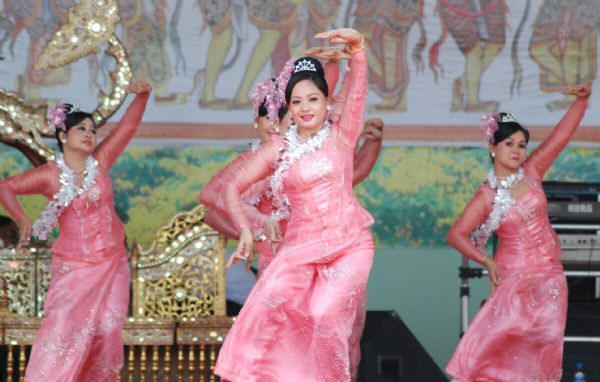
Myanmar's traditional culture is an amalgam of folk and royal culture. Buddhism has been a part of Myanmar's culture since the 1st century AD and has blended with non-Buddhist beliefs. The most conspicuous manifestation of Buddhist culture is the magnificent architecture and sculpture of Myanmar's many temples and monasteries, notably those at Pagan, Mandalay, andYangon.In 1886 the traditional drama appeared to be dying with the elimination of the monarchy, but it had permeated the masses and survived as part of the folk tradition. With the growth of nationalism and regaining of independence, it gathered new strength. The most popular dramatic form is the pwe, which is performed outdoors. There are a variety of pwe genres, but most often the subject matter is taken from the Jatakas, the stories of the former lives of the Buddha. Traditional musical forms, influenced by those from neighboring lands, are highly percussive. Dance forms are derived largely from southern India. Myanmar Religion In Union of Myanmar majority of the population are Buddhist, Theravada Buddhism is professed widely. Religious intolerance or discrimination on grounds of religion is non-existence in the Union of Myanmar throughout it's long history. The main religions of present day Myanmar are Buddhism (89.20%), Christianity (5.05%), Muslims (3.78%), Hindus (0.55%), and Animism (1.27%) and other faiths such as Bahai Sikhs, Lipian fujianhal, Chinese, etc.(0.61%). Theravada Buddhism flourishes in Myanmar .With reference to stone inscriptions, palm leaf inscriptions and court chronicles tell us that Buddhism arrived in Myanmar not once but many times.
Almost 90 percent of Myanmar's population practices Buddhism, a
major religion with some 300 million followers worldwide. Its
two main branches are the Theravada and Mahayana doctrines.
While Theravada Buddhism focuses on individual enlightenment,
the Mahayana tradition seeks to bring salvation to all humans.
One main difference between Mahayana and Theravada is that in
the former, the Buddha of the future Meitrya plays a significant
role and not in the latter, which focuses on the teachings of
Gautama Buddha. The Agar Mha Panditta Ashin Thittila said,
"Theravada Buddhism is not a religion in a sense in which that
word is commonly understood, it is not a system of faith or
worship. It is a path to follow for harmonious living and its
essence is Metta, loving kindness to all creature and
self".Buddhism began about 2,5oo years ago. Buddha means
"Enlightened One" and refers to northern Indian prince Siddharta
Gautama (c. 563-483 B.C.). Prince Siddharta left a life of
privilege to wander the world as a poor, religious man in search
of the meaning of life. After many years of seeking and a period
of intense meditation, he finally reached a peaceful state of
mind that was free from all worldly desires. Buddhists call this
plane of existence nirvana, or the state of Enlightenment.
Shin-byu: The Making of a Monk
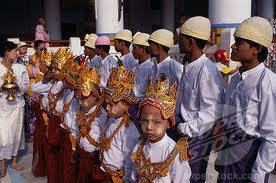
Shin-byu is a religious ceremony that all Buddhist boys are
expected to undergo. It is considered the highest merit-earning
act for the family. During the ceremony, would-be monks, or novices, are
dressed in fine clothes to imitate the Buddha's early life as a prince.
The boys are then carried, paraded on a horse, or taken in a car around
the neighborhood. Their families hold elaborate feasts. Then comes the
head shaving rite, which symbolizes giving up a life of luxury. A boy's
parents usually hold out a white towel to collect his hair as his head
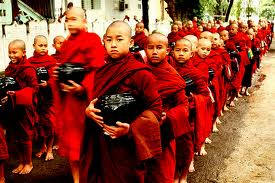
is shaved. Newly shorn novices say prayers in Pali with monks, then
enter a monastery, usually only for a few days or a week - shin-byu
monkhood is temporary. At the monasteries, the novices learn to
meditate, read the Buddhist Scriptures, and do humble tasks, such as
sweeping the premises and running errands for the monks. Shin-byu is so
important in Myanmar cultural life that families without sons
occasionally "adopt" nephews, male cousins, or other boys to hold the
ceremony. Towns and villages sometimes hold mass cerem.
ARTS & LITERATURE
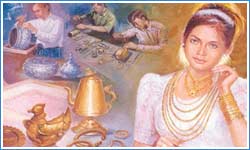
Wood carving, lacquer work, gold work, silverwork, and the sculpting of
Buddhist images and mythological
figures also survived during colonial rule; there has been a revival of
these indigenous art traditions under government patronage. Both the arts of
bronze casting among the Burmans and of making bronze drums
among the Karen, however, disappeared. The traditional
marionette show also declined, although occasionally there
have been attempts to revive it. The cinema and rock music are two Western
art forms that have been accepted in the cultural life of Myanmar.Burmese literature is an
intimate blend of religious and secular genres. It remained alive throughout
the colonial period and, both in verse and prose, has continued to thrive. A
later (though not entirely new) development was biography, which has become
more popular than fiction. Government-sponsored awards are given annually
for the best translation, the best novel, and the best biography. There are state schools of dance, music, drama, and fine arts at Yangon and Mandalay. The National Museum is at Yangon, and there are regional museums at Pagan, Mandalay, and other regional centers.
Myanmar arts
In addition to the traditional arts are silk weaving, pottery, tapestry
making, gemstone engraving, and
gold
leaf making. Temple architecture is typically of brick and stucco,
and pagodas are often covered with layers of gold leaf while monasteries
tend to be built of wood (although monasteries in cities are more likely
to be built of modern materials). A very common roofing style in Burmese
architecture is calledpyatthat
, which is a multi-tiered and spired roof.Myanmar's
woodcarving emerged before the Bagan period and subsequently improved in
the middle of the Bagan era. The temples and palaces of the old were
magnificently decorated with carved wooden gables and eaves, and other
fabulous ornamentation comprised of the most creative and intricate
woodcarvings. It is a pity that many examples of the true genius of
Myanmar wood carvers have suffered in the course of time but,
fortunately, some of the most exquisite woodcarvings still survive in
monasteries and pagodas.The Shwezigone Pagoda in Bagan, Shwedagon Pagoda
in Yangon, Shwenandaw Monastery in Mandalay contain ornamentation of
filigree-like woodcarving with scrolls, flowers, animals and
supernatural-beings arranged in intricate patterns. Carvings of nats, or
mythical traditional spirits, marionettes, and figures of animals still
flourishes today.
The craft of turnery started to develop in the Bagan period around the 8th century A.D. The artisans produced wood products using the turner's lathe. This craft also owed much to Mons of Suvunna Boumi.The turner produced items of diverse shapes such as boxes, bowls, containers, beads, and kitchen utensils. Now this craft thrives mostly because of the tourism industry.
Pandain
Panchi
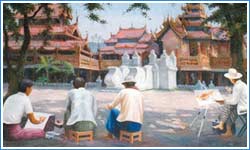
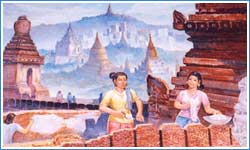
The history of Myanmar's painting can be traced back to pre-historic times. Stone age paintings have been discovered in Padalin cave, in the Shan State. Nine wall paintings, and brown-colored sketches were found there.The 11th century Bagan mural paintings have strong Indian influence and floral patterns are the main elements of the paintings. The Bagan period artists excelled in line drawing, and popular techniques included fresco, oil painting and tempera painting. Most of the paintings depict the 550 Jatakas (Buddha stories).Inwa paintings began depicting the social life of the people, and only red and green paints were mainly used in the murals.In early Konebaung era (17th century), the paintings marked the transition from Myanmar traditional flat painting to western styles of perspective and tones. Blue colour was generously used and the paintings recorded the lifestyles, entertainment and scene of that era.In the Yadanabone era western style painting began to penetrate, but traditional line sketches remained intact.During the colonial era western styles and modern techniques were introduced and became popular. Contemporary art also flourished in the 20th century, and now Myanmar contemporary art is mainly impressionistic.In ancient times palm leaf painting and parchment painting flourished. Some of these paintings can be found intact in some pagodas and monasteries and at the National Museum of Myanmar.
Music of myanmar Various types of Burmese music use an array of traditional musical instruments, assembled in an orchestra known as hsaing waing[4] which the Burmese saing saya Kyaw Kyaw Naing has made more widely known in the West. Traditional folk music is atypical in Southeast Asian music, as it is characterized by sudden shifts in rhythm and melody as well as change in texture and timbre.[5]An instrument unique to Burma is the saung-gauk,[4] an arched harp that can be traced to pre-Hittite times. Classical traditions of Burmese music are found in the Mahagita, an extensive collection of classical songs and are typically divided into indoor and outdoor ensembles. These songs tend to be about various legends in Pali and subsequently in Burmese intermingled with Pali, related to religion or the power and glory of monarchs, and then the natural beauty of the land, forests and the seasons, eventually feminine beauty, love, passion and longing, in addition to folk music sung in the paddy fields. Pop music, however, dominates the music of Burma today, both adopted and homegrown.
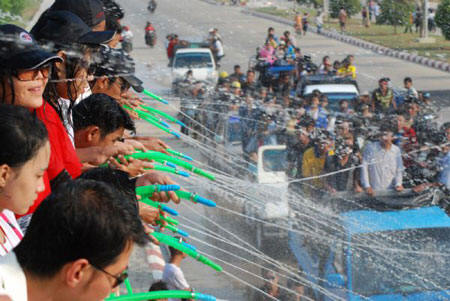
Festivals of Myanmar Among the many festivals in Myanmar, Thingyan is the merriest and one of the few observed all over the country. Thingyan welcomes the Myanmar New Year by washing away the dirt of the body and bad memories of the old year. Everyone who ventures out of the house risks getting doused from head to toe by enthusiastic revellers. As it so very hot no one minds this a bit. Young people enjoy it most of all. Although they act scared of being soaked, it is a fine way of showing off to the opposite sex. Thingyan Festivals Thagyamin, King of the Celestials, visits earth every year at this time in human form. The festival starts on the day of his descent, and ends with his ascent back to his celestial kingdom four or five days later. It is believed that during his stay on earth Thagyamin examines every human being and inscribes the names of all the good on a golden tablet, while the bad are recorded on a dog-skin. Parents warn their children to behave and not kill or steal or tell lies because 'Thagyamin is watching'. Thagyamin is also custodian of the Buddha's teachings. He is a good-hearted god who helps all those in need. The word Thingyan comes from a Sanskrit word meaning 'the passing of the sun from Pisces into Aries'. The day of Thagyamin ascent marks the beginning of the Myanmar New Year, and usually falls at the end of the second week of April.
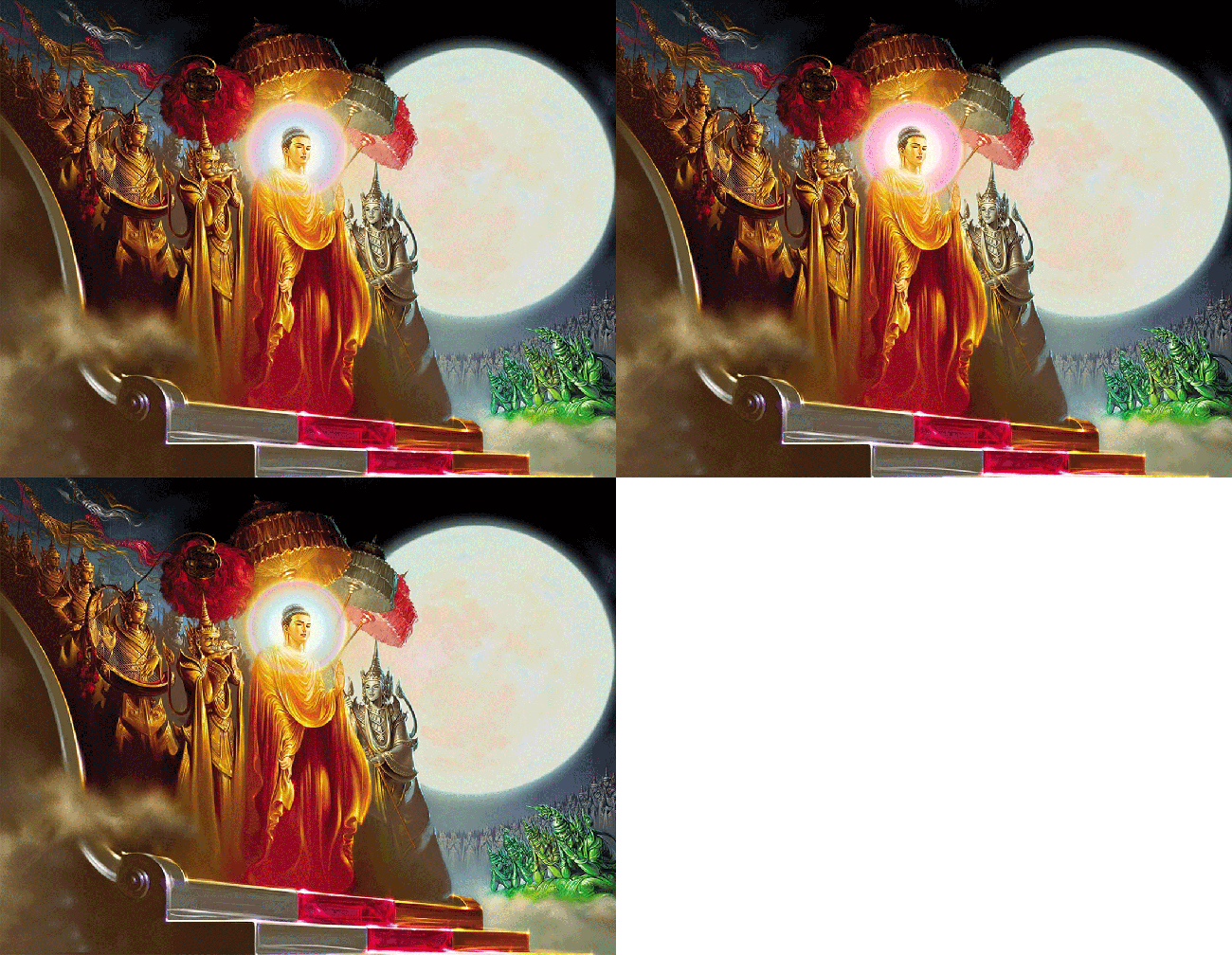
Thingyan is the most exciting event of the Myanmar year. From early morning, young people prepare their equipment at every street corner including water tanks, buckets, pumps and hoses. Nobody, except the very old or sick, and monks, escapes a soaking, regardless of their religion or nationality. Many organisations, government offices, private companies and individuals build decorated pandals (platforms) from which to drench passing motorists and pedestrians. In big cities like Yangon, Mandalay and Mawlamyine, boys and girls drive from one pandal to another to splash and be splashed. There is a lot of singing and dancing, traditional as well as modern. In Mandalay, huge decorated floats carry singers, dancers and musicians around the town performing at the various pandals. Thadingyut, Myanmar festival of lights, is celebrated at the end of Lent (September/October). Houses and state buildings in Myanmar are ablaze with lantern, candles, or electric bulbs. Young people show their respect for elders by formally presenting them with gifts of food or longyi. This festival observes the event when the Buddha came down to the earth after the end of Lent. At the festival, there are concerts and zat (Myanmar traditional theater) in every cities. People are usually crowded in the stalls near those concerts. Thadingyut - Festival of Lights
The festival of Hta-ma-ne The festival of Hta-ma-ne celebrates in the month of Tabodwei (January/February). A tasty rice pudding is made from glutinous rice, peanuts, ginger, sesame seeds, and shredded coconut. The sticky mixture is stirred in huge pans, then divided into small amounts,wrapped in banana leaves to monks and guests. banana leaves to monks and guests.
|
|||||||||||||||||||||
|
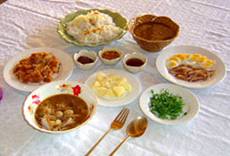
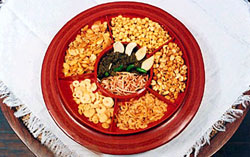
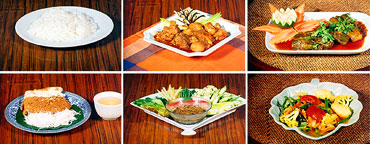
Myanmar Traditional Foods Because Myanmar has diverse geographical features, favourable seasonal conditions and is naturally endowed with fertile soil and water resources, it boasts an abundant supply of food in a great variety all year around.Myanmar people enjoy rice as their main food and it comprises about 75% of the diet. Rice is served with meat or fish, soup, salad and vegetables all cooked in their own ways, and some relishes to complement the meal.
During meals, all the dishes are laid out on the dining table
and served together so that diners can make their own choices
and combinations. Although the dishes are prepared in a variety
of ways, the most common method is to cook meat or fish in oil,
seasoned with pounded onion, garlic, ginger, turmeric, chili and
spices, and simmer until all or most of the water evaporates.
The essential and most popular condiment is a kind of relish
made from preserved fish or prawn, served with chili powder.Most
traditional snacks, which are rich in variety and taste, are
generally made with rice or glutinous rice.
Myanmar lies between two great and very different cultures which
have influenced not only religion, culture and arts, but also
the preparation of food. During the colonial period, the influx
of Chinese and Indians also had an impact on Myanmar traditional
food, introducing new items. With the advent of globalization
and trade liberalization, most famous foods from around the
world are available in the cities, yet the majority of Myanmar
people still cherish their own food, ensuring that its essence
and uniqueness remains unchanged.
|
|||||||||||||||||||||