|
Map of Myanmar |
About Myanmar
Myanmar, formerly known as Burma, is recognized by the world as the
Golden Land. It is one of the earliest homes of mankind, where one
can have exclusive experiences of a life-time. Myanmar sits
at the crossroads of Asia’s great civilisations of India and China,
and looks out onto the vast Indian Ocean next to Thailand. One of
South East Asia’s largest and most diverse countries, Myanmar
stretches from the sparkling islands of the Andaman Sea in the south
right up into the Eastern Himalayan mountain range. Myanmar offers all the traditional delights of Asia in one fascinating country. Virgin jungles, snow-capped mountains and pristine beaches, combined with a rich and glorious heritage spanning more than two thousand years. Spectacular monuments and ancient cities attest to a vibrant culture that is still home to 135 different ethnic groups.The country is divided into states, divisions, townships, wards and villages. In 2006 the capital of Myanmar was moved from Yangon (formerly Rangoon) to Nay Pyi Taw.
|
||||||
|
Geography
Myanmar has
the total area of 676,577 sq. km, it is twice the size of Vietnam
and about the size of United Kingdom and France combined.
Geographically, Myanmar is the largest country in South-East Asia
Peninsula sharing borders with Bangladesh, India, China, Laos and
Thailand. |
|||||||
|
Environment
|
|||||||
|
Architecture
Bagan (Pagan),
a region in central Myanmar by the Ayeyarwady, is the most important
architectural site in Myanmar.Myanmar is most famous for its temples
and pagodas, with the Shwedagon Pagoda the most well known.Until
recently only religious buildings such as pagodas were made of
stone; all other buildings were of wood - even the royal palaces. In
the countryside traditional village homes are made from bamboo and
wood. |
|||||||
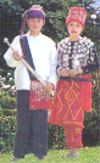 Kachin |
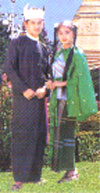 Kayah |
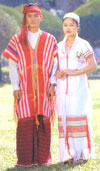 Kayin |
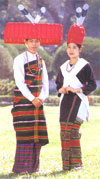 Chin |
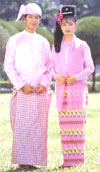 Bamar |
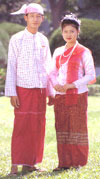 Mon |
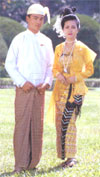 Rakhine |
 Shan |
|
People Myanmar is an agrarian country with a population of more than 50 million, about 90 percent of whom live in rural areas. More than 130 different national groups live within the country’s borders. The Bamar are the majority group inhabiting the central zone, while the Shan, Kayin, Kachin, Kayah, Chin, Rakhine and Mon and their sub-groups live in mountainous regions closer to the borders or along the coast. Buddhism is the predominant religion, but there are also substantial numbers of Christians, Hindus, Muslims and animists throughout the country. |
|||||||
|
languages Burmese is the main language but minorities have their own languages, for example, Karen, Shan and Mon. English and Chinese are also spoken. |
|||||||
|
Food
Rice is the staple food, often eaten with curry and stir-fry
vegetables. |
|||||||
|
Climate The climate of Myanmar is generally humid, and it receives less rainfall but the temperature remains quite mild all through the year. Myanmar has three seasons a year. Cold season, from mid-October to mid-February, is the best time to visit as it is characterized by milder temperatures, which drop to near freezing in the highlands in December and January, and modest rainfall. Summer is from mid-February to mid-May, when maximum temperatures in many parts of the country often exceed 40 degrees Celsius. Torrential deluges are common during the rainy season, from mid-May to mid-October. |
|||||||
|
Natural Resources Myanmar is rich not only in traditions; the fertile land is crossed by a number of rivers that are used for transportation and irrigation, and also as a source of food. Myanmar is very rich in natural resources like petroleum, timber, tin, antimony, zinc, copper, tungsten, lead, coal, some marble, limestone, precious stones, natural gas and hydropower. Mines have yielded some of the world’s finest rubies and imperial jades, while the sea off the southern coast is prime breeding ground for cultured pearls of excellent luster. The country’s natural resources also include a stunning array of flora and fauna, from elusive tigers and elephants, to rare birds, butterflies and orchids. Many of these species are protected by Myanmar’s system of national parks and wildlife sanctuaries. |
|||||||

Myanmar is one of the most pleasant places created by Mother Nature.The Country is unique in so far it has managed to preserve its beautiful natural environment, traditional customs and ancient cultural heritage unlike so many countries where concrete has been the order of the day.We hope you can see that what Myanmar is about – simple but charming beauty of the landscapes, lots and lots of golden Pagodas, and very kind people who at any time look like they are going to carnival from this webpage.
This page was created by Nyo Nyo San(Myanmar).