Pondaungia
Recent excavations in Pondaung area suggests Myanmar history has evolved through stone age. Primate fossils found in Pondaung are the evidence of the existence of man-like creatures 40 million years ago, which has been approved by some internationally renowned achaeologists.
Mon
|
|


The first historically recorded inhabitants were the Mon, who from the 6th century BC settled all over the south, in the Ayeyarwady Delta and along the Gulf of Mottama (Martaban), as well as along the Chao Phraya river in modern-day Thailand. The Mon had flourishing cultural and economic links with India, and it was through these that Buddhism made its way into
Burma, Myanmar. Legend has it that the mysterious land of Suvarnabhumi (or "Golden Land"), mentioned in numerous ancient sources and the subject of much debate, was in fact the homeland of the Mon, who established their first kingdom in Myanmar in 300 BC around the port of Thaton, which developed into an important trading center.Pyu
|
|


From the 1st century AD, the Pyus settled in central Myanmar. They were also quick to espouse Buddhism, and they founded highly civilized city-kingdoms which, at their peak, during the 7th and 8th centuries, also became prosperous trading centers. The largest city was Sri Ksetra, close to present-day Pyay (Prome). Pyu had built towns in Sri Ksetra (Pyay) 4-8AD, Maingmaw, Beikthano. (Actually Vishnu from Hindu god), Taung Dwin Gyi 1-4 AD,, Hanlin (Wet Let) 2-9AD, Tagaung (Thabeikkyin), Waddi (Nga Htwoe Gyi), Maingmaw (Pinlay) (Myittha), Beinnaka (Pyaw Bwe), and Bilin (Mon state). It is believed the first Kayin (Karen) and Chin provided the next wave of immigrants to central Myanmar, before the Myanmar people came from Nanzhao during the 9th century.
Bagan, Pagan, Pyugama
 Nanzhao,
meaning in Chinese "The Lord of The South" was a
powerful kingdom in
Nanzhao,
meaning in Chinese "The Lord of The South" was a
powerful kingdom in
By the tenth century the Nanzhao empire had slowly faded from history. Some time around, the tribes in the west under their mang (chiefs) began filtering south, and finally occupying the fertile rice lands in Kyauk-Se region, near present-day Mandalay. They called themselves the Mranma or the horsemen.
|
|


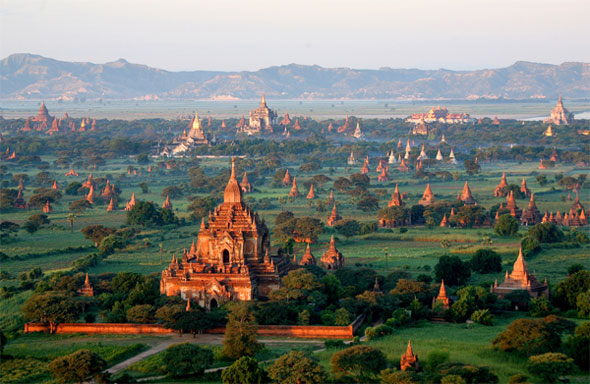
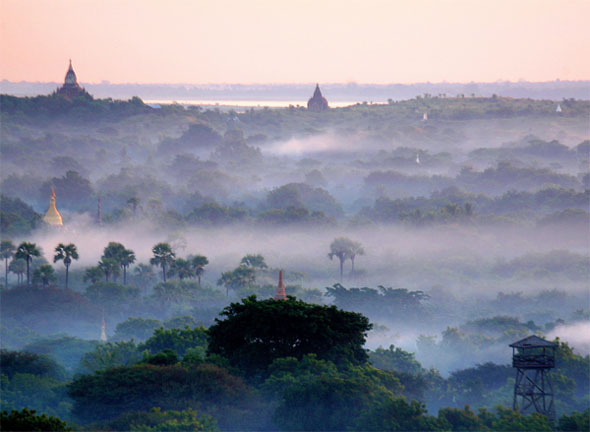
In 849, seventeen years after the Nanzhao's cavalry had last swept the towns of the Ayeyarwady Valley, Bagan was founded as a fortified settlement along a bend in the Ayeyarwady river. Within two hundred years Bagan had become the center of a great Buddhist kingdom, and its ruins today are one of the most magnificent sites in all Southeast Asia. The Myanmar chronicles say that after the Nanzhao invasions a new dynasty arose, founded by a semi-mythical warrior king named Pyusawhti. It seems very likely that he was connected in some still slightly mysterious way with the old and fallen house of Nanzhao. The ruling class of Nanzhao had a peculiar naming system, in which the last name of the father became the first name of the son. This was the naming system of Pyusawhti and his descendants for seven generations. Somehow, two hundred years of Nanzhao Empire had washed up on the banks of Ayeyarwady and would find a new life, fused with an existing and ancient culture, to produce one of the most impressive kingdoms of the medieval world. From this fusion would result the Myanmar people and the foundations of modern Myanmar culture.
Anawrahta
|
|


For two hundred years or so this new kingdom at Bagan slowly gained ground. Then in the eleventh century came a great burst of human energy in the form of Anawrahta (Aniruddha), who seized the throne as a teenager in 1044 after killing his cousin in single combat. The chronicles remember him campaigning in every directions, aided by his four captains. He also led his men to the old Nanzhao heartland and then built a line of fortified towns at the foothills of the Shan plateau to guard against any fresh incursions. He unified the Ayeyarwady Valley under a single sovereign and created a kingdom that matched fairly closely the borders of today's Myanmar. Anawrahta was followed by a line of able kings. Together they erected thousands of temples and hundreds of monasteries, libraries, and colleges and repaired and constructed the dams and weirs that made middle Myanmar a great producers of rice.
Myanmar travel visitors to Bagan today will have a good intimation of the onetime prosperity and splendor of this medieval Buddhist kingdom. There remain a multitude of temples and pagodas, thousands by some accounts, some in ruins but many in good repair.Mongol hordes in the thirteenth century brought terror and destruction to enormous swaths in Europe and Asia, and Myanmar was no exception.
Bagan was already by then in decline, but the Mongol invasions hastened the demise of the kingdom. Myanmar was never integrated into the Mongol imperial adminstration but was nevertheless, for a few years, under the distant authority of Peking and Xanadu.Taking advantage of the ensuing turmoil after the fall of Bagan, the Mons moved south and founded a new kingdom in Bago
in lower Myanmar. The Shan also broke away and extended their territory westward, establishing a capital in Innwa on the banks of the Ayeyarwady. Some Myanmar families of court officials withdrew to Toungoo on the Sittaung River to await an opportunity to initiate the reunification of Myanmar, which did not happen for another 260 years.Tabinshwehti and Bayinnaung
|
|


In 1541 the Myanmars under Tabinshwehti took advantage of the frequent wars between the Shans and Mons and captured Innwa and Bago. After his death, however, the kingdom again fell apart.
King Tabinshwehti's brother-in-law and successor, King Bayinnaung later re-conquered all the lost territory, won Chiang Mai and Ayuthia from the Siamese, and took back Tanintharyi, thus founding the Second Myanmar Empire. Other states on the Myanmar-Chinese border and Manipur, now part of India, paid tribute to Bayinnnaung.
During this period, trade with neighboring countries developed; Bago became an important port for traders traveling to China via the Ayeryarwady and northern Myanmar. It was also a convenient stop for traders going to other parts of Southeast Asia by way of Thanlyin, Mottama, and Pathein, which were important ports in Lower Myanmar.
Foreigners, especially Arabs and Portuguese, were very active in east west trade. The British, French, and Dutch trading companies were established in Myanmar in the 17th century when the capital was moved from Bago to Innwa. During the 18th century, the Shans became weaker, and the Mons, with help from the French, captured Innwa in 1752.
Konbaung Dynasty
Alaungpaya
|
|

After conquering Innwa, the Mons tried to control all Myanmar until the Myanmar headman of a tiny village tract, Alaungpaya (Alompra), defeated them. After eight years of war, King Alaungpaya was able to unite the country again and founded the Konbaung dynasty, the third and last Myanmar dynasty. He also moved the capital to Innwa.
Hsinbyusin, Alaungpaya's son and successor, invaded Siam (present day Thailand) and destroyed Ayuthia in 1767. As a result, Tanintharyi was again under Myanmar control. This victory brought to Myanmar Siamese dancers, musicians, and artisans who later influenced
Myanmar arts.Another development during this time was the conquest of
Rakhine by Hsinbyushin's brother, Bodawpaya. During his reign, Bodawpaya improved the tax collection, communications, legal, and educational systems.The British Rule
|
|


In 1886, after three wars with the British, Myanmar became a British colony. The three Anglo-Myanmar wars in 1824, 1852 and 1885 had their origin in British economic and political interests in Myanmar.
After the first war, Myanmar lost Rakhine and Tannintharyi. In 1852, the British annexed Lower Myanmar in order to close the gap between Calcutta and Singapore, and they made it a province of British India. In 1885 Myanmar tried to make contact with the outside world, especially France, during the reign of the last king, Thibaw. The British, fearing French interference and wanting a monopoly in teak, used a dispute between Myanmar and a British timber firm, accused of illegal logging, as an excuse to march to
Mandalay, the capital at that time. In 1886 all of Myanmar became a province of British India, and the royal family was exiled to India.The British introduced the classic divide-and-rule principle, giving the minority states permission to be ruled by their own leaders. They did not recruit ethnic Myanmar for their army. All important posts in the civil service were filled by Indians or other foreigners. Myanmar's natural resources were exploited by foreigners and profits channeled out of the country. The British allowed Indians to migrate to Myanmar to alleviate labor shortages in the rice fields. All these factors inspired the Myanmar nationalists to rebel against the British.
|
|


|
|


In the early 20th century, the nationalist movement, under the leadership of the Young Men's Buddhist Association (YMBA) and Rangoon University student leaders, grew in strength. During World War 2, General Aung San led the struggle against the British and the Japanese who occupied the country during the war. After the war the British finally gave Myanmar its independence.
Aung San
|
|


|
|


General Aung San is Myanmar's national hero and the father of Myanmar's independence. He started his political career as a young student leader at
Yangon University, founding the Thakin movement together with other students. The members of this movement, dissatisfied with having to address the British as thakin (master) - feeling that this demeaned the Myanmar people - termed themselves thakin and wore traditional Myanmar clothes.During World War 2, Thakin Aung San formed the Thirty Comrade, a group of 30 young men who swore a blood oath. They secretly went to Japan to ask for help and training to remove the British from Myanmar. The Japanese, however, proved to be ruthless when they came to Myanmar. Towards the end of World War 2, Aung San and his Burma Independence Army (BIA) sought the help of the British to drive out the Japanese.
After the war, General Aung San continued to negotiate for independence, which was won on January 4, 1948. Sadly, he did not live to see the day. On July 19, 1947, General Aung San was assassinated, together with six cabinet ministers, at the age of 32.
By the Constitution of 1947 Myanmar was formed as a
quasi - federal Union, with Kachin, Kayah, Kayin and
Shan States as constituent states, and with a
governmental system in which the cabinet was
responsible to a bicameral legislature made up of
the Chamber of Deputies and Chamber of
Nationalities. The AFPFL dominated early
post-independence polities, but the country was much
troubled by a widespread insurgency and the
intrusion of Kuomintang forces retreating from
China. The AFPFL Government attempted to follow a
liberal socialist economic policy and launched the
eight-year pyidawtha Plan in 1952 in order to
realize a welfare state.
The Caretaker Government and Its Aftermath
Because of a split with the ruling AFPFL, the
Parliament appointed the Chief of Staff General Ne
Win as head of a Caretaker Government on 28 October
1958 and entrusted him with the task of holding fair
and free parliamentary elections. During its tenure
of office the Caretaker Government brought about the
end of feudal rule in the Shan and Kayah States and
concluded an agreement delimiting the boundary
between Myanmar and China. It held elections on 6
February 1960 and on 4 April 1960 handed over power
to the Pyidaungsu Party, which had won the
elections. However, the political situation rapidly
deteriorated under the new government with a split
developing within the Pyidaungsu Party,
dissatisfaction against the making of Buddhism the
State religion, and the development of a movement
for the creation of a truly federal state.
Revolutionary Council
A military coup on 2 March 1962 resulted in the
establishment of a Revolutionary Council, which
formed Security and Administrative Committees down
to the ward and village levels and attempted to
restore the security situation. Proclaiming a
General Amnesty on 1 April 1963, it started
negotiations with various insurgent groups and
concluded an agreement with the Kayin Revolutionary
Council on 12 March 1964. The Revolutionary Council,
taking a socialist stand, formed the Burma Socialist
Programme Party (BSPP) as a nucleus party on 4 July
1962 and announced its philosophy in The Correlation
of Man and His Environment in January 1963. In line
with its socialist stand, the Revolutionary Council
nationalized many economic enterprises and started
on the First Four-Year Plan in 1971. The BSPP,
developing from a nucleus party to a people's party,
held its First Congress from 28 June to 11 July
1971. The Congress decided on the drafting of a
state Constitution and a commission was appointed in
September 1971. The constitution which was drafted
and submitted to a popular referendum was adopted on
3 January 1974. Elections were held and the
Revolutionary Council handed over power to the BSPP
Government on 2 March 1974.
BSPP Government
The Constitution of 1974, drawn up on socialist
principles, designated the BSPP as the leading
party. Under the guidance of the BSPP, the
unicameral Pyithu Hluttaw, elected on universal
suffrage, was the superme State organ, enacting laws
and appointing the executive and judiciary. Three
new States-Chin, Mon and Rakhine were created in
addition to the four existing ones. The BSPP, which
was the ruliganized on the principle of democratic
centralism from the Central Committee down to the
level of the party cell. It held regular Party
Congresses in 1971, 1973, 1977, 1981 and 1985 and a
number of extraordinary Congresses. It was supported
by two class organizations, the Peasants Asiayon and
Workers Asiayon, as well as by the Lanzin Youth
Organizing Committee. Continuing the economic
policies of the Revolutionary Council, the BSPP
Government in 1973 startd implementing the 20-Years
Economic Plan whose guidelines were adopted by the
2nd Party Cogress in October 1973 and which looked
to the doubling of per capita GNP, the
transformation of Myanmar from an agricultural
country to an agro-based industrial country and the
all full realization of socialist relations of
production by 1994. Because of a general
dissatisfaction with the social and economic
situation, a movement of protest developed in August
1988 which soon deteriorated into disorder and
anarchy. To prevent a further deterioration of the
situation, the Armed Forces took on the
responsibility of government on 18 September 1988.
State Law and Order Restoration Council
The Armed Forces which took on the responsibility of
government on 18 September 1988 formed the State Law
and Order Restoration Council (SLORC) with Chief of
Staff General (later Senior General) Saw Maung as
Chairman. Senior General Saw Maung retired on 23
April 1992 and was succeeded by General (later
Senior General) Than Shwe. Committing itself to the
national causes of non-disintegration of the Union,
non-disintegration of national solidarity and
consolidation of national sovereignty. SLORC gave
priority to the restoration of law and order, the
improvement of communications and the uplift of
people's livelihood. It moved away from the
centrally planned economy of the BSPP period and
towards a market-oriented economy relaxing the
former restrictions and private industry and trade
and offering incentives to attract foreign
investment. It also promoted tourism and designated
1996 as Visit Myanmar Year. SLORC declared its
intention of creating a multi-party democratic State
and towards that end, held fair and free elections
on 27 May 1990 and convened a National Convention on
6 January 1993 to draw up the guidelines for the
drafting of a new Constitution. SLORC took
initiatives to end the insurgency, which had
troubled the country since independence and
concluded cease-fire agreements with most of the
armed ethnic groups. With peace restored in the
border areas, SLORC extended and intensified its
development and drug eradication programmes in the
border areas and established a separated Ministry
for the development of the border areas. In the
country as a whole SLORC embarked on a construction
programme, which included the building of bridges,
roads and railway lines to improve communications,
the building of dams and reservoirs to expand
cultivation, and the building of satellite towns and
better housing to improve living conditions. Under
SLORC, Myanmar, adhering to an active and
independent non-aligned foreign policy, participated
in the activities of the United Nations and its
agencies, cultivated friendly relations with all
countries, especially its neighbours, and took an
active part in regional affairs, joining the
Association of South-East Asian Nations on 23 July
1997.
STATE PEACE AND DEVELOPMENT COUNCIL
On 15 November 1997 SLORC was reorganized as the
State Peace and Development Council (SPDC) in order
to better carry out its task of making Myanmar a
modern, developed nation.