ABOUT CUBA
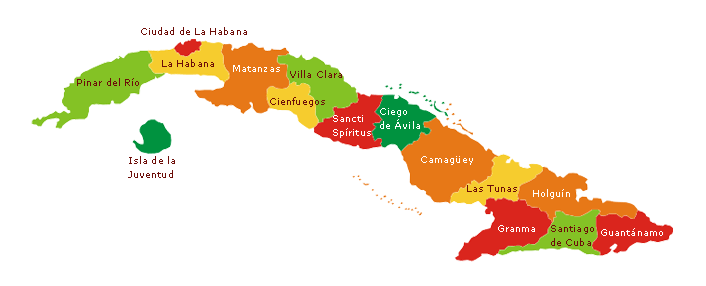
Cuba, the "Pearl of the Antilles," is the largest. Its picturesque colonial towns, intriguing culture, rousing revolutionary monuments.
Havana, with 2.1 million inhabitants, is the largest city in the Caribbean. Founded on its present site in 1519, it is one of the oldest cities in the Americas.
The Spanish built protective fortresses of solid stone to keep out
pirates and their European enemies, and these outposts still guard
picturesque Old Havana, a designated UNESCO World Heritage Site,
whose charm is truly captivating. The richness of Cuba's culture is
well reflected in its many museums, several dozen of which are in
Havana.
The capital is a world-class artistic center with numerous
galleries, theaters and literary centers gracing the quaint colonial
streets and squares. Cuba truly is a musical watershed where the
rumba, mambo, cha cha cha, son and salsa all originated.
Cuba is a fascinating smorgasbord of nonstop discovery and
experience. The Cuban people are sincerely friendly.
This is one of the last truly unspoiled countries in the world,
practically free of the crime and drug trade.
The First Ibero-American nations, including Spain and Portugal who had the first cemetery was isolated from churches in 1806 CUBA
FIRST NATION OF HISPANIC AMERICA, SPAIN AND PORTUGAL to use machines and steamships were CUBA in 1829.
The third in the world nations (after England and the U.S.) that had railroad was Cuba in 1837.
Etymology
The name Cuba comes from the Taíno language. The exact meaning of the name is unclear but it may be translated either as where fertile land is abundant (cubao), or great place (coabana).
- Population: 11.2 million (UN, 2009)
- Capital: Havana
- Area: 110,860 sq km (42,803 sq miles)
- Major language: Spanish
- Major religion: Christianity
- Life expectancy: 77 years (men), 81 years (women) (UN)
- Monetary unit: 1 Cuban peso = 100 centavos
- Main exports: Nickel, sugar, tobacco, shellfish, medical products, citrus, coffee
- GNI per capita: Estimated to be upper middle income: $3,946 to $12,195 (World Bank, 2009)
- Internet domain: .cu
- International dialling code: +53
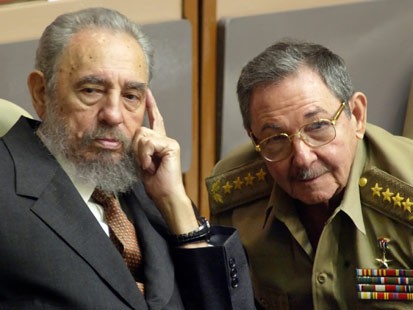
- President: Raul Castro Ruz

Cuban was first applied in Latin America ether anesthesia in 1847.
SHOW FIRST WORLD ELECTRICITY driven industry was in Havana in 1877.
In 1881, he was a Cuban doctor, Carlos J. Finlay who discovered the transmitting agent of yellow fever decimated villages and indicated prevention and treatment.
The first system of electric street lighting throughout Latin America (including Spain) settled in Cuba in 1889.
Between 1825 and 1897 Spain received from Cuba between 60 and 75% of all gross income from abroad.
It was Cuba that abolished BULLFIGHTS before the end of the eighteenth century, as "unpopular, unfair and vicious to animals"
The extraordinary VOICE Cuban soprano Rosalie (Chalía) Herrera, famous opera was one of the first to be recorded on cylinders and discs plates.
The first tram that circulated in Latin America met in Havana in 1900.
Also in 1900, before any other country in Latin America came to Havana, the first car.
It was the Cuban writer Renee Mendez Capote's first Ibero-American women driving a car.
LATIN AMERICAN FIRST OLYMPIC CHAMPION was a Cuban. In 1900, the fencer Ramon Fonts.
The world's first city to have direct dial TELEPHONY (without operator) was Havana in 1906.
In 1907 he premiered in Havana the FIRST X-ray department of Latin America.
On May 19, 1913 was the first flight by the Cuban Latin American Air Agustin Parla and Domingo Rosillo, which lasted two hours and 40 minutes between Cuba and Key West.
In 1915 he coined the FIRST CUBAN PESO with a value from day one identical to the dollar, many times until 1959, exceeding one cent to U.S. dollar.
The first Latin American country to grant a divorce to couples in conflict was Cuba in 1918, when enacting the law.
The first Latin American to win the World Chess Championship was the Cuban Jose Raul Capablanca, in turn the first world chess champion, born in an underdeveloped nation. He won all World Championships between 1921 and 1927.
In 1922 Cuba was the second nation to inaugurate a WORLD RADIO STATION (The PWX) and the first nation in the world radiate a concert and present a radio news.
ANNOUNCER The first was a Cuban world: Esther Perea de la Torre.
In 1928 Cuba was already 61 RADIO STATIONS, 43 of them in Havana, ranking fourth in the world, second only to U.S., Canada and the Soviet Union. It was Cuba, the first in the world in number of stations per number population and land area.
The beauty of Cuban women make in 1933, the son of Alfonso XIII, the Prince of Asturias, Alfonso de Borbon y Battenberg, renounce their rights as successor to the Spanish throne to marry the Cuban Edelmira Robato Sampedro.
In 1935 Cuba became the largest exporter to Latin America in Books and Recordings radio. Is created by the Cuban Felix B. Caignet the concept of novel and radio series.
In 1937 Cuba decreed for the first time in Latin America the LAW OF WORKING HOURS OF 8 HOURS, the minimum wage and university autonomy.
In 1940, Cuba became the first country in Latin America to have a BLACK PRESIDENT OF THE RACE, elected by universal suffrage by an absolute majority when the majority of its population was white race. In this forward 68 years to U.S.
In 1940, Cuba adopted the most advanced of all the world's constitutions of the time. It was the FIRST IN LATIN AMERICA recognize the vote to women, equal rights between sexes and races, and the right of women to work. The feminist movement in Latin America first appeared in the late thirties in Cuba. He advanced to Spain 36 years which did not recognize Spanish women the right to vote, the power of their children, no right to a passport or open an account bank unless it was authorized by her husband, until 1976 .
In 1942, a Cuban became the first Latin American musical director of a global film production and FIRST AMERICAN TO RECEIVE AWARD OSCAR NOMINATIONS. Your name: Ernesto Lecuona.
LATIN AMERICAN WOMAN WHO FIRST SONG IN LA SCALA MILAN (1946) was the Cuban Zoila Gálvez. The second was Marta Pérez in 1950.
The second in the world that TV was formally issued Cuba since 1950. The biggest stars of all America, not enjoyed in their countries of such payment, went to Havana to act before the cameras in Cuba.
In 1950 a Cuban musician set a world record not matched either by Elvis Presley and the Beatles. Damaso Perez Prado was with his piece "Patricia" (mambo) which spent 15 consecutive weeks in the U.S. Hit Parade
In 1951 a Cuban becomes the largest producer of American television: Desi Arnaz, also the first in the world in the use of a third television camera
THE FIRST WORLD HOTEL CENTRAL AIR CONDITIONING was built in Havana: The Hotel Riviera in 1951
FIRST APARTMENT BUILDING BUILT WITH CONCRETE world was made in Havana (The FOCSA) in 1952.
In 1953 this building was built in the latest TV studio in the world of that time: (CMQ Television).
In 1954, Cuba has a cow for every person. Ranked third in Latin America (after Argentina and Uruguay) in meat consumption per capita
In 1955, Cuba is the second country in Latin America with lower infant mortality. (33.4 per thousand births)
In 1956 the UN recognized Cuba as the second country in Latin America with the lowest illiteracy rates (only 23.6%). Haiti had 90%, Spain, El Salvador, Bolivia, Venezuela, Brazil, Peru, Guatemala and the Dominican Republic 50%
In 1957 the UN recognized Cuba as the best country of Latin America in number of doctors per capita (1 per 957 inhabitants), with the highest percentage of homes ELECTRIFIED
(82.9%) and OWN HOMES WITH BATH (79.9%) and the second country in Latin America (behind Uruguay) in calorie consumption per capita daily (2870).
Havana in 1957 became the second city in the world to have 3D multiscreen cinema (The Cinema Radiocentro)
In 1958 Cuba is the second in the world to spread color TV and the third channel has a color TV from around the world.
In 1958, Cuba is a country of Latin America MORE CARS (160 thousand, one per 38 inhabitants). The most appliances had. The country with the most kilometers of railways per km2. and the second in the total number of radio receivers.
Throughout the fifties, Cuba had the second and third place in admissions per capita in Latin America, surpassing Italy and more than double those of Spain. Despite its small size and had only 6.5 million in 1958 occupied the position 29 among the largest economies in the world.
In 1959, Havana was the world's city with the largest number of theaters: (358) ahead of New York and Paris, occupying the second and third respectively.