







 Sri Lanka: Traditions and Customs Customs and traditions are deeply ingrained in Sri Lankan society and have been safeguarded, from one generation to the next, over its rich 2,500 year old history. These traditions are intertwined with day to day life of the island’s four ethnic groups – the Sinhalese, Tamils, Muslims, and Burghers – and its religions – Buddhism, Hinduism, Islam, and Christianity.
Traditional greeting
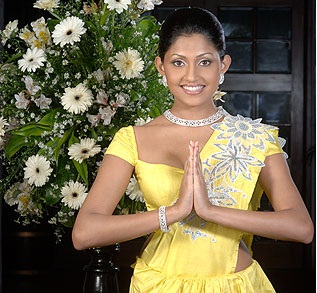
In our island home, you will be greeted with clasped palms, as if in prayer, and a head nodded in welcome; the words “Ayubowan” – “May You Live Long” – forming on each islander’s lips. The equivalent greeting in Tamil is “Vanakkam”, whilst the Muslims will say “Assalamu Alaikum”. 
Traditions: From Birth and Beyond The traditions found below are an intrinsic part of the lives of primarily the island’s Sinhalese and Tamils. From birth, important rituals are conducted around culturally significant milestones such as the Naming Ceremony and a child’s first feeding of solid food. Naming Ceremony The ‘Nam Tebima’ or Naming Ceremony is an important ritual in traditional Sinhalese society. An Astrologer, based on the time of birth, provides a selection of letters with which to name the child (usually, a selection of letters with which both the first and middle name should start with is given). Sri Lankan law requires a newborn to be registered within 90 days of birth.
First Meal of Solids
Kandyan
Dance (Uda Rata Netum)
The Kandyan dance form flourished under the Kandyan Kingdom, Sri Lanka’s last kingdom. There are four types of Kandyan dance – Pantheru, Ves, Naiyadi, and Udekki. In addition, there are 18 Vannamas (representation in dance of animals and birds), which include the Gajaga Vannama (Elephant) and the Mayura Vannama (Peacock). Under the Kandyan kings, this dance form became an integral part of the Kandy Esala Perahera, the 10-day long magnificent festival held to honour the tooth relic of the Lord Buddha and invoke blessings from the gods for abundant rainfall.
Low Country Dance (Pahatharata Dance)
Low country dances are highly ritualistic and are performed to appease evil spirits which cause sickness. Dancers wear masks depicting characters in the form of birds, demons, reptiles, etc. If the mnemonics of the drum govern the form of the dance, this is illustrated well in the low country dances of Sri Lanka where the ‘Yak Bera’ (or the ‘Demon Drum’) plays an important role. The rather free and easy movement and basic rhythm of the ‘Devol Dancer’ (dance to appease the deity, Devol) combined with a very elementary mime danced to the ‘Yak Bera’ typifies low country dancing. The ‘Devol Madu’ (or occasions for the propitiation of the gods) for the dance of appeasement of the gods is the low country parallel of the Kohomba Kankariya. 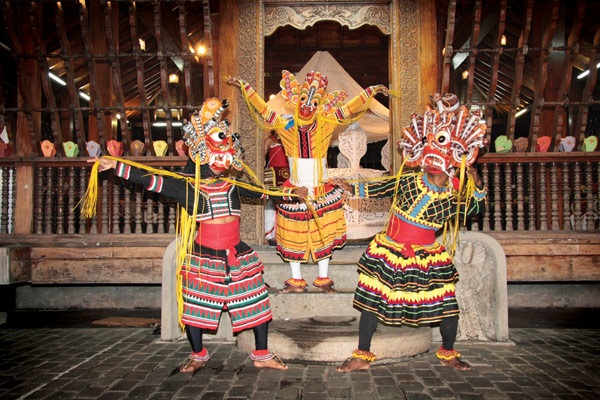 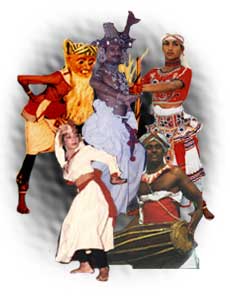
Traditional
Dress
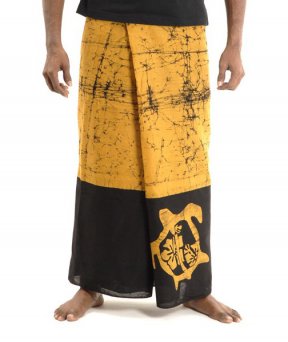
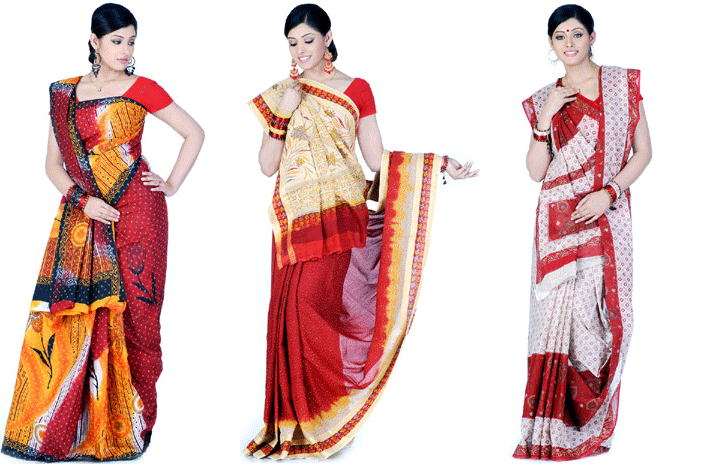
Sarong A sarong is a garment consisting of a length of printed/plain cloth wrapped about the waist. Sarongs are the standard garment for most men in rural and even some urban communities. In cities, you will see a mix of Western clothes and the traditional sarong. Sari A sari usually consists of six yards of often brightly coloured cloth wrapped around the body. In cities, you will see a mix of Western clothing as well as the traditional sari. Religions of Sri Lanka

society. Though Buddhism
is the major religion, other religions
such as Hinduism, Christianity and Islam
are also followed. 
|