Rabindranath Tagore [1861-1941]
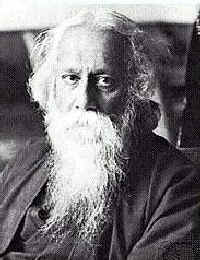 |
Rabindranath Tagore, the Nobel laureate poet, writer, philosopher was the ambassador of Indian culture to the rest of the world. He is probably the most prominent figure in the cultural world of Indian subcontinent and the first Asian to be awarded with Nobel prize. Even though he is mainly known as a poet, his multifaceted talent showered upon different branches of art, such as, novels, short stories, dramas, articles, essays, painting etc. And his songs, popularly known as Rabindrasangeet, have an eternal appeal and is permanently placed in the heart of the Bengalis. He was a social reformer, patriot and above all, a great humanitarian and philosopher. India and Bangladesh - the national anthems of these two countries are his composition.
Tagore was born on Tuesday, 7th May 1861 in a
wealthy family in Calcutta at 6, Dwarakanath Thakur Lane, Calcutta. He
was son of Debenadranath and Sarada Devi and the grand son of
Dwarakanath Tagore, a rich landlord and social reformer. He could not
cope with the conventional system of education and started study at
home under several teachers. He translated a part of
Shakespare's Macbeth into Bengali verse which was later published in Bharati
magazine. His first book of poems, Kabi Kahini ( tale of a poet
) was published in 1878. In the same year, he sailed to England with
his brother Satyandranath. He got admitted into the University College
in England and started studying under Prof Henry Morley. Retuned to
India in 1880.Got married to Bhabatarini Devi in 1883 at the age of
22. Later her name was changed to Mrinalini Devi. By this time he
had already been established as a leading writer of Bengali
literature.
In 1890 Tagore attended session of Indian National Congress and on the
opening day sang Vandemataram composed by Bankim Chandra
Chattapadhayay, the exponent of novel in Bengali literature. In 1901
he took the editorial charge of the magazine Bangadarshan. Got
involved with freedom fighting movement. Established Bolpur
Bramhacharyaashram at Shantiniketan, a school in the pattern of
old Indian Ashrama. He strongly protested Lord Curzon's
decision to divide Bengal on the basis of religion. Wrote a number of
national songs and attended protest meetings. He introduced the Rakhibandhan
ceremony , symbolizing the underlying unity in undivided Bengal. In
1909 started writing Gitanjali at Silaidaha. Composed
Janaganamana in 1911 which later became the national anthem of
India.
In 1912 went to Europe for the second time. On his journey to London
he translated into English some of his poems/songs from Gitanjali. He
met William Rothenstein, a noted British painter, in London. Earlier
he was introduced to Rothenstein in Calcutta at a gathering at
Abanindranath Tagore's house before. Rothenstien was impressed by the
poems, made copies and gave to Yeats and other English poets. He
arranged a reading in his house where Yeats read Tagore's poems in
front of a distinguished audience comprising of Ezra Pound, May
Sinclair, Ernest Rhys etc. Tagore sailed for America ( for the first
time ) from England. Reached New York, came to Urbana, Illinois, gave
a lecture and went to Chicago. In the mean time Gitanjali ( song
offerings ) containing 103 translated poems of Tagore was published in
London. Yeats wrote the introduction for this book and Rothenstein did
a pencil sketch for the cover page. The book created a sensation in
the English literary world. Tagore delivered lectures in Rochester,
Boston, Harvard University. Ezra Pound's "Poetry"
Magazine published from Chicago had the honor of publishing the first
English poem of Tagore. His six Gitanjali poems appeared in Poetry
in December, 1912 issue. The poet returned to Calcutta. 13th
November, 1913, Indians came to know that the Nobel prize for
literature had been awarded to Tagore for Gitanjali. On
26th Decemeber, University of Calcutta conferred on him the honorary
degree of "D.Litt.". Received Knighthood in 1915.
Proceeded to Japan in 1916. On his way gave speeches at Rangoon,
Singapore, Hongkong. In September, 1916 got invitation from different
institutions in USA and reached Seattle ( Washington). Lectured at
Portland, San Fransisco, Los Angeles, Santa Barbara, Salt Lake City,
Chicago, Iowa, Milwakee, Detroit, Cleveland, Philadelphia, Boston. At
Columbia Theatre, New York read translation from his novel Raja.
Returned to Calcutta in 1917. In 1919, the poet started a tour to
South India. Delivered lectures on different topics at Bangalore,
Mysroe, Ooty, Coimbatore, Palghat, Salem, Trichy, Sirangapatnam,
Kumbakonam, Tanjore and Madras. At Madras spoke as Chancellor of
National University, founded by Annie Besant and stayed as a guest of
Mr. Besant at Adyar. In 1919, he wrote a historic letter to Lord
Chelmsford repudiating his Knighthood in protest against the massacre
at Jalianwalabag, Punjab. In 1920 he went to Gandhiji's Sabarmati
Ashram and visited Ahmedabad, Surat and Bombay. Call came from Europe
again in 1920. Delivered lectures at New York, Princeton, Chicago and
came back to Europe. His effort to raise fund for Viswabharati
was not very fruitful in America, mostly because he was seen as an
anti-British and pro-German. He continued talks at Geneva, Zurich,
Humburg, Copenhaegen, Stockholm, Berlin, Frankfurt, Vienna, Prague and
in other cities.
In 1921, established Viswabharati University. He gave all his
money from Nobel Prize and royalty money from his books to this
University. Went to Bombay and from there to Poona. Visited and
lectured at Mysore, Bangalore,Coimbatore, Trivandam, Cochin and
Colombo. Got invitation from China and visited Sanghai, Peiking.
Visited Japan again in this tour. Went to South America. Met Argentine
poet Madam Victoria Ocampo at Buenos Ayres. The poet gave her a name ,
Vijaya and wrote Purabi - a collection of poems dedicated
to her. On the return journey visited Italy and lectured in Milan,
Venice, Florence. Mahatma Gandhi visited Santiniketan on the poet's
birthday. In 1926 visited Dacca, Moimonsingha, Comilla. Visited Europe
again and this time went to Norway, Sweden, Denmark, Czechoslovakia,
Huungary, Bulgaria, Rumania, Greece and Egypt. In 1927 went to
Malayasia, Java, Thailand. In 1929 Canada. In 1930 Russia. In 1932
Iran, Iraq. And in 1934 to SriLanka.
In 1940 Oxford University arranged a special ceremony in Santiniketan
to honor the poet with Doctorate Of Literature. Tagore passed away on
7th August, 1941.
Sad demise of his beloved ones came almost in a procession but with
the placidity of a yogi he tolerated the shock and it never could stop
both his creative and constructive activities. In all his literary
output he searched after the eternal values of life: human, aesthetic
and deeply spiritual; his songs specially are endowed with all the
different shades and forms of love which often transcends to the love
for God and also God's love for man.