Mother Teresa [1910-1997]
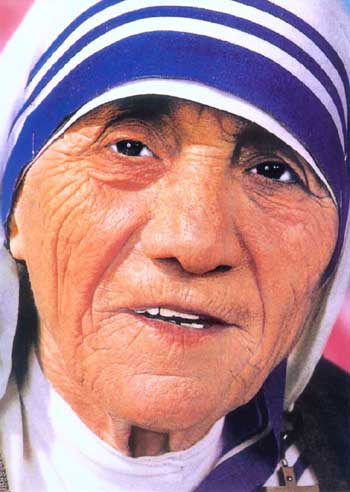 |
“By blood, I am Albanian. By citizenship, an
Indian. By faith, I am a Catholic nun. As to my calling, I belong to
the world. As to my heart, I belong entirely to the Heart of Jesus.
”Small of stature, rocklike in faith, Mother Teresa of Calcutta
was entrusted with the mission of proclaiming God’s thirsting love
for humanity, especially for the poorest of the poor. “God still
loves the world and He sends you and me to be His love and His
compassion to the poor.” She was a soul filled with the light of
Christ, on fire with love for Him and burning with one desire:
“to quench His thirst for love and for souls.”
This luminous messenger of God’s love was born on 26 August 1910 in
Skopje, a city situated at the crossroads of Balkan history. The
youngest of the children born to Nikola and Drane Bojaxhiu, she was
baptised Gonxha Agnes, received her First Communion at the age of five
and a half and was confirmed in November 1916. From the day of her
First Holy Communion, a love for souls was within her. Her father’s
sudden death when Gonxha was about eight years old left in the family
in financial straits. Drane raised her children firmly and lovingly,
greatly influencing her daughter’s character and vocation.
Gonxha’s religious formation was further assisted by the vibrant
Jesuit parish of the Sacred Heart in which she was much involved.
At the age of eighteen, moved by a desire to become a missionary,
Gonxha left her home in September 1928 to join the Institute of the
Blessed Virgin Mary, known as the Sisters of Loreto, in Ireland. There
she received the name Sister Mary Teresa after St. Thérèse of
Lisieux. In December, she departed for India, arriving in Calcutta on
6 January 1929. After making her First Profession of Vows in May 1931,
Sister Teresa was assigned to the Loreto Entally community in Calcutta
and taught at St. Mary’s School for girls. On 24 May 1937, Sister
Teresa made her Final Profession of Vows, becoming, as she said, the “spouse
of Jesus” for “all eternity.” From that time on she
was called Mother Teresa. She continued teaching at St. Mary’s and
in 1944 became the principal of the school. A person of profound
prayer and deep love for her religious sisters and her students,
Mother Teresa’s twenty years in Loreto were filled with profound
happiness. Noted for her charity, unselfishness and courage, her
capacity for hard work and a natural talent for organization, she
lived out her consecration to Jesus, in the midst of her companions,
with fidelity and joy.
On 10 September 1946 during the train ride from Calcutta to Darjeeling
for her annual retreat, Mother Teresa received her “inspiration,”
her “call within a call.” On that day, in a way she would
never explain, Jesus’ thirst for love and for souls took hold of her
heart and the desire to satiate His thirst became the driving force of
her life. Over the course of the next weeks and months, by means of
interior locutions and visions, Jesus revealed to her the desire of
His heart for “victims of love” who would “radiate His
love on souls.” “Come be My light,” He begged
her. “I cannot go alone.” He revealed His pain at the
neglect of the poor, His sorrow at their ignorance of Him and His
longing for their love. He asked Mother Teresa to establish a
religious community, Missionaries of Charity, dedicated to the service
of the poorest of the poor. Nearly two years of testing and
discernment passed before Mother Teresa received permission to begin.
On August 17, 1948, she dressed for the first time in a white,
blue-bordered sari and passed through the gates of her beloved Loreto
convent to enter the world of the poor.
After a short course with the Medical Mission Sisters in Patna, Mother
Teresa returned to Calcutta and found temporary lodging with the
Little Sisters of the Poor. On 21 December she went for the first time
to the slums. She visited families, washed the sores of some children,
cared for an old man lying sick on the road and nursed a woman dying
of hunger and TB. She started each day in communion with Jesus in the
Eucharist and then went out, rosary in her hand, to find and serve Him
in “the unwanted, the unloved, the uncared for.” After some
months, she was joined, one by one, by her former students.
On 7 October 1950 the new congregation of the Missionaries of Charity
was officially established in the Archdiocese of Calcutta. By the
early 1960s, Mother Teresa began to send her Sisters to other parts of
India. The Decree of Praise granted to the Congregation by Pope Paul
VI in February 1965 encouraged her to open a house in Venezuela. It
was soon followed by foundations in Rome and Tanzania and, eventually,
on every continent. Starting in 1980 and continuing through the 1990s,
Mother Teresa opened houses in almost all of the communist countries,
including the former Soviet Union, Albania and Cuba.
In order to respond better to both the physical and spiritual needs of
the poor, Mother Teresa founded the Missionaries of Charity
Brothers in 1963, in 1976 the contemplative branch of the
Sisters, in 1979 the Contemplative Brothers, and in 1984 the Missionaries
of Charity Fathers. Yet her inspiration was not limited to those
with religious vocations. She formed the Co-Workers of Mother
Teresa and the Sick and Suffering Co-Workers, people of
many faiths and nationalities with whom she shared her spirit of
prayer, simplicity, sacrifice and her apostolate of humble works of
love. This spirit later inspired the Lay Missionaries of Charity.
In answer to the requests of many priests, in 1981 Mother Teresa also
began the Corpus Christi Movement for Priests as a “little
way of holiness” for those who desire to share in her charism
and spirit.
During the years of rapid growth the world began to turn its eyes
towards Mother Teresa and the work she had started. Numerous awards,
beginning with the Indian Padmashri Award in 1962 and notably the
Nobel Peace Prize in 1979, honoured her work, while an increasingly
interested media began to follow her activities. She received both
prizes and attention “for the glory of God and in the name of the
poor.”
The whole of Mother Teresa’s life and labour bore witness to the
joy of loving, the greatness and dignity of every human person, the
value of little things done faithfully and with love, and the
surpassing worth of friendship with God. But there was another heroic
side of this great woman that was revealed only after her death.
Hidden from all eyes, hidden even from those closest to her, was her
interior life marked by an experience of a deep, painful and abiding
feeling of being separated from God, even rejected by Him, along with
an ever-increasing longing for His love. She called her inner
experience, “the darkness.” The “painful night”
of her soul, which began around the time she started her work for the
poor and continued to the end of her life, led Mother Teresa to an
ever more profound union with God. Through the darkness she mystically
participated in the thirst of Jesus, in His painful and burning
longing for love, and she shared in the interior desolation of the
poor.
During the last years of her life, despite increasingly severe health
problems, Mother Teresa continued to govern her Society and respond to
the needs of the poor and the Church. By 1997, Mother Teresa’s
Sisters numbered nearly 4,000 members and were established in 610
foundations in 123 countries of the world. In March 1997 she blessed
her newly-elected successor as Superior General of the Missionaries of
Charity and then made one more trip abroad. After meeting Pope John
Paul II for the last time, she returned to Calcutta and spent her
final weeks receiving visitors and instructing her Sisters. On 5
September Mother Teresa’s earthly life came to an end. She was given
the honour of a state funeral by the Government of India and her body
was buried in the Mother House of the Missionaries of Charity. Her
tomb quickly became a place of pilgrimage and prayer for people of all
faiths, rich and poor alike. Mother Teresa left a testament of
unshakable faith, invincible hope and extraordinary charity. Her
response to Jesus’ plea, “Come be My light,” made her a
Missionary of Charity, a “mother to the poor,” a symbol of
compassion to the world, and a living witness to the thirsting love of
God.
Less than two years after her death, in view of Mother Teresa’s
widespread reputation of holiness and the favours being reported, Pope
John Paul II permitted the opening of her Cause of Canonization. On 20
December 2002 he approved the decrees of her heroic virtues and
miracles.