Swami Vivekananda [1863-1902]
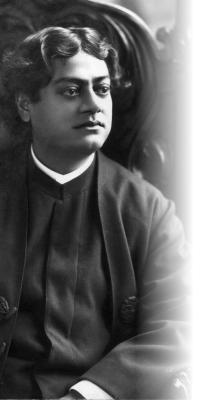 |
Swami
Vivekananda was born Narendranath Dutta, son of a well-known lawyer in
Calcutta, Biswanath Dutta, and a very intelligent and pious lady,
Bhuvaneswari Devi, in the year 1863. Even in his very childhood
Narendranath developed the power of independent thinking and would
say: Point out where I'm wrong, but why should you object to my
independent thinking? He was a natural leader. He was much sought
after by the people because of his various accomplishments.
Narendranath passed Entrance Examination from the Metropolitan
Institute and F.A. and B.A. Examinations from the General Assembly's
Institution (now Scottish Church College). Hastie, Principal of the
College, was highly impressed by Naren's philosophical insight. It was
from Hastie that he first heard of Sri Ramakrishna.
As a student of Philosophy, the quest for God burned in his mind. Is
there a God ? If there is a God, what is He like ? What is man's
relation with Him ? Did He create this world which is so full of
anomalies ? A relation of his used to advise him to visit Ramakrishna
at Dakshineswar, who, he said, would be able to remove all his doubts
about religion.As the days passed, Naren began to grow restless about
the various riddles that religion presented to him. He particularly
wanted to meet a person who could talk about God with the authority of
personal experience. Finally, he went to Ramakrishna one day and asked
him straightway if he had seen God. Sri Ramakrishna said he had, and
if Naren so wished, he could even show him the same. He began to watch
him from close quarters and after a long time he was left in no doubt
that Ramakrishna was an extraordinary man. Naren loved and admired
Ramakrishna but never surrendered his independence of judgment.
Interestingly, Ramakrishna himself did not demand it of him, or of any
other of his disciples. Nevertheless, Naren gradually came to accept
Ramakrishna as his master.
Ramakrishna suffered from cancer and passed away in 1886. During his
illness, a group of select young men had gathered round him and began
to nurse him while receiving spiritual guidance from him. Naren was
the leader of this group. Ramakrishna wanted that they would take to
monastic life and had symbolically given them 'Gerua'. They
accordingly founded a monastery at Baranagar and began to live
together, depending only upon alms. Sometimes they would also wander
about like other monks. Naren also would sometimes go travelling. It
was while he was thus travelling that he assumed the name Vivekananda.
Vivekananda travelled extensively through India, sometimes on foot. He
was shocked to see the conditions of rural India-people, ignorant,
superstitious, half-starved, and victims of caste-tyranny. If this
shocked him, the callousness of the so-called educated upper classes
shocked him still more. He appealed to all to do something for the
masses. No one seemed to pay any heed to him, except the Maharaja of
Mysore, the Maharaja of Khetri and a few young men of Madras. Swami
Vivekananda impressed on everybody the need to mobilize the masses. A
few educated men and women could not solve the problem of the country;
the mass power had to be harnessed to the task. He wanted the masses
to be educated. It was a kind of 'non-formal' education which perhaps
he visualized. His letters to the Maharaja of Mysore on the subject
show how much he had given to the subject and how original he was.
Other princes, or the intelligentsia as a whole, were impressed by
Swamiji's personality, but were much too engrossed with their own
affairs to pay any heed to his appeals. Swamiji could guess the reason
why the so-called leaders of the society ignored him. Who was he ? A
mere wandering monk. There were hundreds of such monks all over the
country. Why should they pay any special attention to him ? By and
large, they followed only Western thinkers and those Indians who
followed the West and had had some recognition in the West by so
doing. It pained Swamiji to see such slave mentality of fellow
Indians. Later he would call out the nation and say, 'Feel proud that
you are Indians even if you're wearing a loin-cloth'. He was not
opposed to learning from the West, for he knew the Western people had
some great qualities and it was because of those qualities that they
had become so rich and powerful. He wanted India to learn science and
technology from the West and its power to organize and its practical
sense, but, at the same time, retain its high moral and spiritual
idealism. But the selfishness of the so-called educated people pained
him more. They were happy if they could care for themselves and they
gave a damn to what happened to the people. Swamiji wanted to draw
their attention to the miserable condition of the illiterate mass.
As Swamiji arrived in Madras, young people gathered round him drawn by
his bright and inspiring talks. They begged him to go to the USA to
attend the forthcoming Parliament of Religions in Chicago to represent
Hindu relegion and philosophy. They even started raising funds for the
purpose. Swamiji was first reluctant but later felt some good might
come of his visit to the West. That is exactly what happened. It was a
clarion call to the youth's of India. Swamiji made a tremendous
impression, first in the USA and then also in England. The press paid
him the highest tributes as an exponent of India's age-old values;
overnight he became a great national hero in India. This was the
starting point of the Indian renaissance. The freedom fighters during
the British rule have drawn inspiration from Swami Vivekananda. 'If
you want to know India, study Vivekananda', was Rabindranath Tagore's
advice to Romain Rolland.
It was Swamiji's hope that India would create a new social order and a
new civilization by combining her best spiritual traditions with the
latest advancements in science and technology. She would be rich both
materially and spiritually. He knew that affluence was not enough, man
had to be human too. Through his realisation of the unique harmony
that lies in all he wanted India to set an example before the whole
world. "Arise, awake and reach the goal" was his message.
To make the whole world know the treasures of Hinduism, Swami
Vivekananda translated chatur-yogas in English. He also
established Ramakrishna Mission to propagate the ideal of Sri
Ramakrishna by performing selfless service to all. Swamiji used to say
'We belong to Cast-less Cast'; neither religion nor any cast or creed,
Swami Vivekananda enthused the youth of India and of the whole world
to realize one's own self.