
| cwave.eu5.org
Also see: http://www.angelfire.com/dragon/letstry cwave04 at yahoo dot com |
 Last updated on Tue May 25 14:31:15 IST 2010. |
|

Factorial design (part 2)
Effects
Now we shall define a concept that is deceptively similar to runs. We shall again consider the subsets of the letters. But this time we shall not allow the empty subset, and shall use capital letters. Thus we shall denote {A,C} by AC. This is called an effect. There is no effect called 1. Also, just like runs, we must preserve the alphabetic order. Effects with a single letter are called main effects. Others are called interactions. An interaction with 2 letters is called a 2-factor interaction, and so on. We can multiply two effects just like runs. The product of two or more effects is called their generalised interaction. This term is not used for runs, though the multiplication rule is the same in the both the cases. Note that a generalised interaction need not be an interaction. For example, the generalised interaction of AB and A is just B, which is a main effect. By the way, we cannot multiply a effect with itself, as that would cancel all the letters (remember that there is no effect called 1)!The ``value'' of an effect for a run
This concept is best explained through an example. Take an effect and a run: ABD and bcd, say. We shall think of the run bcd as a formula: x2 + x3 + x4 (mod 2). The effect will provide values for the variables. Since A,B and D are present in ABD we shall take x1 = x2 = x4 = 1 and x3 = 0. Then the ``value'' of ABD for bcd isNote that the value is always either 0 or 1. It is 0 iff the run and the effect have an even number (possibly 0) of letters in common.
1+0+1 (mod 2) = 2 mod 2 = 0.
Example:
Find the following values: ABC for abc, A
for bc, BCD for 1.
Solution:
Of course, we could also count number of letters shared by the effect and the run in each case. |

Confounding
A replicate is said to confound an effect if the effect clashes with all the runs in the control block of the replicate.
Example:
Consider the replicate with following control block in a (24 , 22 )
experiment
Does this replicate confound A? CD? ACD? Solution: No, it does not confound A because A does not clash with a (they share an odd number, 1, of letters). CD is confounded as it clashes with all the effects. It shares 0 letter with each run in the block. (0 is an even number.) ACD shares exactly one letter with a, and so is not confounded. |
Creating a replicate from the confounded effects
If we are given a list of all the (independent) effects to be confounded we can construct the control block, from which we can construct the entire replicate. Thus it is meaningful to talk about the replicate confounding a given list of effects.Total, partial and balanced confounding
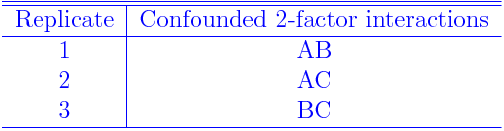
Almost always we shall work with more than one replicate. By an (2n ,2r ) experiment we shall understand a collection of such replicates. It is quite possible that an effect that is counfounded in one replicate is not confounded in another. In this case we say that the effect is partially confounded in the experiment. If an effect is confounded in all the replicates then it is totally confounded. If an effect is not confounded in any replicate in an experiment then we say that the experiment does not confound that effect. We sometimes say that an experiment confounds all the 2-factor interactions in a balanced way. By this we mean each 2-factor interaction is confounded in the same number of replicates. For example, in a (23 , 22 ) experiment there are 3 factors, and so the number of 2-factor interactions is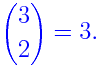 If we use 3 replicates, and use the
following confounding scheme
If we use 3 replicates, and use the
following confounding scheme
then we have balanced confounding of the 2-factor interactions, as each 2-factor interaction is counfounded in the same number of replicates (1, in this case). Sometimes we want to confound both 2-factor and 3-factor interactions in a balanced way. This means balancing the 2-factor interactions and then balancing the 3-factor interactions separately: any two 2-factor interactions must be confounded in an equal number of replicates. Similarly, any 3-factor interactions must be confounded in an equal number of replicates. It is not required that a 2-factor interaction is confounded in as many replicates as a 3-factor interaction.
Achieving balance
Suppose that we are required to design a (25 ,22 ) experiment such that- all 3-factor interactions are balancedly confounded,
- no main effect or 2-factor interaction is confounded,
- the minimum possible number of replicates is used.
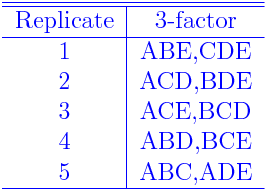
In each replicate we have to confound one or more of these. The more of these we can confound in a single replicate, the better, because then we shall need fewer replicates. However, we have to careful about the generalised interactions which will also get confounded. We must make sure that the generalised interactions do not turn out to be main effects or 2-factor interactions. For example, we cannot confound ABC and ABD in the same replicate, as this would also confound their generalised interaction CD, which is a 2-factor interaction! Similarly, no two 3-factor interactions sharing 2 letters can be confounded in the same replicate. So we can can pair up the 3-factor interactions that share just a single letter:
ABC, ABD, ABE, ACD, ACE, ADE, BCD, BCE, BDE, CDE.
Notice that this requires some trial-and-error. The rest of the process is now routine.
Construction (2-level)
Exercise:
A 24 design has been conducted in 22 blocks of
size 4 each. One of the incomplete blocks, with usual
notation, is
Identify the confounded factorial effects and obtain the layout of the other 3 incomplete blocks. Give the analysis of the design. |
Show hint.
| Exercise: Construct a (24 ,23 ) design with minimum number of replicates achieving balance over 3-factor and 4-factor interactions without confounding any main effect and 2-factor interactions. (Give control blocks only). |
Show hint.
| Exercise: Construct a balanced (25 ,22 ) design with minimum number of replications achieving balance over 3-factor and 4-factor interactions without confounding main effects and 2-factor interactions. (Give control blocks only.) |
Show hint.
| Exercise: In a (25 ,23 ) design only four treatments (1),bc,de,abc are known. Find the other treatments of the block. Also find the confounded effects. |
Show hint.
| Exercise: In a (25 ,23 ) design one of the blocks contains treatments (1), bc, de, abe. Find the other treatments of the block. Also find the confounded effects. |
Show hint.
| Exercise: For a (25 ,23 ) design with the factors A,B,C,D, and E some treatments in one of the blocks are given by a,b,bde,ce. Identify the confounded effects and give the complete allocation for all the blocks. |
Show hint.
| Exercise: In a (25 ,23 ) design only 4 treatments in a block are known (1),bc,de,abc. Find the other treatments of the block. Find the confounded effects. |
Show hint.
| Exercise: Discuss total and partial confounding in conection with factorial experiments. What do you mean by balancing in a confounded design with more than one replicate? Construct a (24 ,23 ) design with minimum number of replicates achieving balance over 3-factor and 4-factor interactions without confounding any main effect and 2-factor interactions. |
Show hint.
