| cwave.eu5.org
Also see: http://www.angelfire.com/dragon/letstry cwave04 at yahoo dot com |
 Last updated on Tue May 25 14:31:14 IST 2010. |
|

Factorial design (part 1)
Basic concepts (2-level)
We shall deal with design as a problem of combinatorics, arranging letters satisfying various conditions. We shall work with (2n ,2r ) experiments where r<n. This means there are n letters. To fix ideas suppose that n=4 and r=3. So we have 4 letters: A,B,C and D, say. The number r will enter the picture later.Runs
Consider all possible subsets of the letters. We shall write the empty subset as 1, and the subset {A,C} as ac. Notice the lower case letters. Also, we shall always preserve the alphabetic order, and never write things like ca or adb. Each such subset is called a run. The special run 1 is called the control run. Note that there are 2n = 24 =16 runs.Product of runs
We shall define a product among runs: a rule to combine two runs to produce a third run. The rule is to simply cancel repeated letters, and then writing the remianing letters alphabetically. For example,Multiplication by 1 does not change anything.
bc × acd = abd.
Blocks
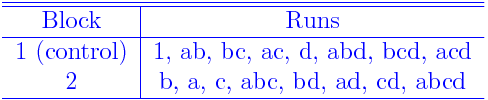
We have not yet made any use of r. Now we bring that in. We have to group the 2n runs into blocks of size 2r . So there are 2n-r blocks. In our example, we have n=4 and r=3. So we shall group the 16 runs into 2 blocks of size 8 each. The block that contains the control run is called the control block. Here is an example:This grouping must satisfy two conditions.
- The first is that the control block must be closed w.r.t. multiplication, i.e., the product of two runs in the control block must again be in the control block. For example, both bd and abd are in the control block. So their product bd× abd = a is also in the control block.
- The second is that if you take any run not in the control block, then multiplying the runs in the control block with it will give the block where it belongs. Let us take b which is not in the control block. Multiplying the control block by b produces block 2. You could also take any other run from block 2, for example, abd.
| Exercise: Multiply all the runs in the control block with abd and check that you get block 2. |
Constructing all blocks from one block
These two properties make life quite simple. Thanks to the second rule we can construct all the blocks if we know any one block. The process is very simple if the known block happens to be the control block.
Example:
In a (23 , 2) experiment the control block is
Find the other blocks. Solution: There are 23-1 = 4 blocks in all. The control block is already given. So we need to find three more blocks. Pick any run not in the control block, say, b. Multiply the control block with it to get another block: Now take some run not in either of these two blocks, say, c. Multiply the control block with it to get yet another block: There should now remain only two runs that constitute the last block. It is a good idea to cross check. So we pick one of these, say, abc, and multiply the control block with it to get:
|
Example:
In a (23 , 2) experiment one block is
Find the other blocks. Solution: The given block is not the control block because it does not contain 1. First we need to recover the control block. This is done by taking one of the runs in the given block and multiplying the block with it. If we pick ab then we get which is the control block. Now proceed as in the last example. |
Completing the control block
Thanks to the first rule we can sometimes construct the control block if we know only some of the runs in it. We just form all possible products of the known runs. If we get enough runs to fill the block (we know that the size of the block must be 2r ) then we have the entire control block.
Example:
In a (24 , 23 ) set up we know that the control block
contains
Find all the runs in the control block. Solution: We form all the products: Since we have 8=23 runs in all, we have found all the runs in the control blocks. |
Example:
In a (24 , 23 ) set up we know that the control block
contains
Can you find all the runs in the control block? Solution: If we form the products we do not get any new run. But the control block is of size 23 =8. So it is not possible to construct the control blocks from only these runs. |
Example:
In a (24 , 23 ) set up we know that a block
contains
Find all the runs in the block. Solution: We shall first arrive at four runs from the control block. For this we shall pick one of the given runs (say, ad) and multiply all the given runs with it: Since the control run 1 is here, these are in the control block. Now complete the control block: So the control block is Multiply this with a run from the given block, say d, to get which is the required answer. |
Replicates
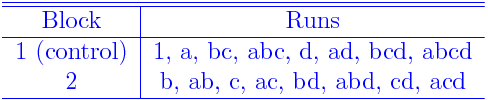
Recall that in a (2n ,2r ) design we have to group the 2n runs into 2n-r blocks of size 2r each. It is possible to do this grouping in different ways. For example, here are two possible groupings in a (24 ,23 ) design:and
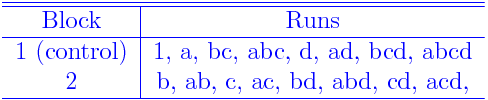
Each such possible grouping is called a replicate. By a (2n ,2r ) experiment we mean a collection of such replicates. Each replicate must have 2n-r of blocks, each of size 2r . However, the contents of the blocks may differ from replicate to replicate.