Abstract: Inverse problems are encountered when required information about a physically unreachable domain needs to be obtained from the data collected at the accessible domain. Due to its frequent occurrence in heat transfer and many other fields, a family of methods has been developed over decades to tackle such problems. Recently, physics-constrained neural networks have shown great promisein providing fast, elegant solutions for inverse problems. In this work, a physics-informed neural network was developed to solve several unsteady inverse heat transfer problems. Using physics-constrained deep neural network model, we were able to predict the temperature profiles across the whole domain and estimate the unknown thermophysical parameters such as the material’s thermal diffusivity and boundary conditions at the inaccessible side (i.e., heat flux) with high accuracy. Furthermore, the method was extended to estimate the time dependent heat flux on the inaccessible side. The predicted temperatures and estimated parameters obtained from our inverse technique are in good agreement with their corresponding exact or true values. However, the physics-informed neural network was not able to predict the heat flux accurately if the boundary temperatures were not used for training the artificial neural network. To overcome this challenge, we have developed a hybrid method coupling the artificial neural network technique with a finite volume method. This hybrid method is capable of predicting the unknown heat flux within 1% of their true values. We also used the hybrid method for a thermal ablation problem with a moving boundary and obtained highly accurate heat flux at the inaccessible side for the thermal ablation problem.
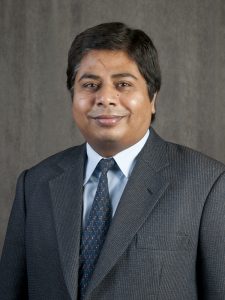
Brief Bio: Prof. Prashanta Dutta is a Professor of Mechanical Engineering and the Director of the NSF NRT-LEAD program at Washington State University (WSU). He received his MS (1997) and Ph.D. (2001) degrees from the University of South Carolina and Texas A&M University, respectively. He joined the School of Mechanical and Materials Engineering of WSU in 2001. During his sabbatical years, he worked as a Visiting Professor at Konkuk University, Seoul, South Korea and the Technical University of Darmstadt, Germany. His primary research area is Micro, Nano, and Biofluidics with a specific focus on the development of new algorithms for multiscale and multiphysics problems. Lately, he developed a suite of physics-based machine learning models for heat and mass transfer problems. He has published more than 200 peer-reviewed journal and conference articles. Prof. Dutta organized and chaired numerous sessions, fora, symposia, and tracks for several ASME (American Society of Mechanical Engineers) and APS (American Physical Society) conferences and served as the Chair of the ASME Micro/Nano Fluid Dynamics Technical Committee. Moreover, he served as an Associate Editor for the ASME Journal of Fluids Engineering; currently, he is an Editor for Electrophoresis. Prof. Dutta is an elected Fellow of ASME and a recipient of the prestigious Fulbright Professorship sponsored by the US Department of State.