In this seminar, I will present an overview of the research activities of my group, the CU Aerospace Nanoscale Transport Modeling (CUANTAM) Laboratory at the University of Colorado Boulder. In CUANTAM Laboratory, we combine concepts from solid state physics, materials chemistry and nano- to microscale device physics, and develop physics-aware AI approaches to model thermal and electronic transport properties of materials in technological applications. I will highlight our research on two topics.
(1) Thermal models of nanoelectronic devices: The state-of-the-art nanometer (nm)-scale microelectronic transistors are heterogeneous structures that include nm-scale semiconductors, dielectric materials and metals, within confining nanoscale dimensions. The confined geometry results in self- heating that accelerates defect generation leading to the decline of the transistors. Heat transport in nm- scale systems can be drastically different from their bulk counterparts. Atomistic modeling techniques have shown remarkable accuracy while predicting thermal conductivities of isolated nanoscale systems, however, the computational costs of first-principles approaches prohibit us to analyze such complex systems. Heat transport in nanoscale systems that include multiple confining surfaces, interfaces, and materials with different degrees of crystallinity or disorder, is far from understood. In this talk, I will discuss how atomistic modeling combined with machine learning methods allow us to overcome this challenge and develop thermal model of nanoscale field effect transistors. Our model reveals the mechanisms responsible for self-heating and informs transistor design with desired thermal budget and power consumption.
(2) Image to Properties—Extracting Atomic Structure Information from Spectroscopy Images: AI- assisted approaches have remarkably accelerated materials design and discovery, however, largely are based on the forward process: one assumes the atomic arrangement of a new material and uses various techniques to model the physical properties of the material. However, to design a material with target properties, an expensive trial-and-error loop is often followed until the target is achieved or novel discoveries are made. The rapid advancements of AI techniques and materials science research present us unique opportunities to disrupt the process and establish a new reverse paradigm for materials discovery. Large number of high-quality characterization images are now easily generated using spectroscopy techniques, such as the angle-resolved photoemission spectroscopy (ARPES). In parallel, AI models have made significant breakthroughs in image generation and processing. We develop a new AI-assisted modeling framework that reads spectroscopy images and predicts the properties of the underlying atomic structure of the materials. Our framework establishes an approach to expedite the design and discovery of complex materials with desired electronic band structures, going beyond combinatorial approaches.
Speaker Bio:
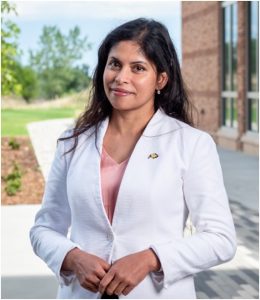
Sanghamitra Neogi is an Assistant Professor at the Ann and H.J. Smead Department of Aerospace Engineering Sciences at the University of Colorado Boulder. Additionally, she is a Program Faculty at the Materials Science and Engineering Program at the University of Colorado Boulder. Prior to joining CU, she received her B.Sc. and M.Sc. in Physics from Jadavpur University, Kolkata, and Indian Institute of Technology, Kanpur, India, respectively. She received her Ph.D. in theoretical condensed matter physics from the Pennsylvania State University and was a postdoctoral research associate at the Max Planck Institute for Polymer Research, Mainz, Germany. Her research received mention in the Journal of Physics D: Applied Physics article “The 2022 applied physics by pioneering women: a roadmap.” She is an Associate Editor for the European Physical Journal B: Condensed Matter and Complex Systems.