
| cwave.eu5.org
Also see: http://www.angelfire.com/dragon/letstry cwave04 at yahoo dot com |
 Last updated on Fri May 21 11:50:25 IST 2010. |
|

Jacobi symbol
Here we shall learn how to compute the Jacobi symbol (a/b), where a is any integer and b is an odd positive integer. We shall employ the following properties of the Jacobi symbol.Property 0: changing sign of a
- If a = -k then
- (a/b) = (k/b) if b=3 (mod 4)
- (a/b) = -(k/b) else.
Property 1: simple cases
- If a=1 then (a/b) = 1.
- If a=0 then (a/b) = 0.
Property 2: draining out 4's
- If a=4k then (a/b) = (k/b).
Property 3: halving
- If a=2k then
- (a/b) = -(k/b) if b=3,5,11,13 (mod 16)
- (a/b) = (k/b) else.
Property 4: remainder
- If a = r (mod b) then (a/b) = (r/b).
Property 5: quadratic reciprocity
- If a is odd then
- (a/b) = -(b/a) if a,b=3 (mod 4)
- (a/b) = (b/a) else
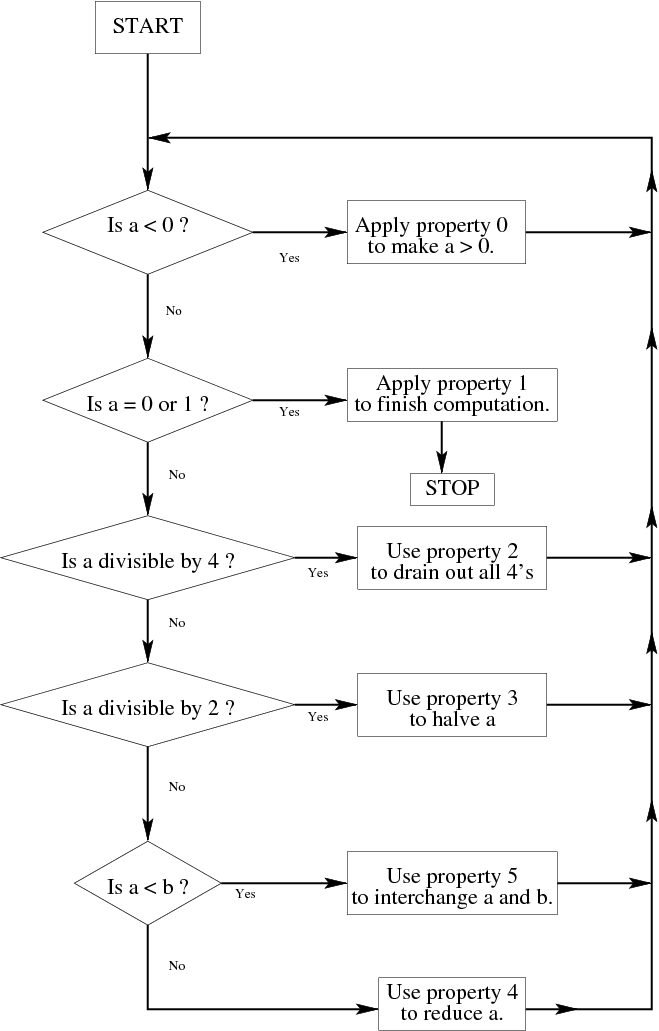
The algorithm
 |
Implementing in C
#include <stdio.h> int jacobi(int a, int b) { int sgn = 1; int tmp, r;
if(b%2==0) { printf("b must be odd.\n"); return 2; }1 if(a<0) { a = -a; if(b%4==3) sgn = 1; else sgn = -1; }2 while(1) {if(a==1) { return sgn; } else if(a==0) { return 0; }3 else if(a%4==0) { a /= 4; }4 else if(a%2==0) { a /= 2; r = b%16; if(r==3 || r==5 || r==11 || r==13) sgn = -sgn; }5 else if(a<b) { tmp = a; a = b; b = tmp; if(a%4==3 && b%4==3) sgn = -sgn; }6 else { a = a%b; }7
Explanation of the code:
- 1:
- First we are making sure that b is indeed odd.
- 2:
- If a<0 then we use property 0 to make a positive.
- 3:
- If a=0 or 1 then we can apply property 1.
- 4:
- If a is divisible by 4 then we can divide a by 4.
- 5:
- If a is even then we can use property 3.
- 6:
- If a<b then use quadratic reciprocity.
- 7:
- If a
 b then use property 4.
