|
18/10/2010: Ukhimath to Khatara
There are many who find it difficult to sleep in an unaccustomed
place. Rasmohan-da was one of them. On the other hand, the only sleeping problem that I have is to fall asleep whenever
I can. So I was taken aback when next morning Rasmohan-da looked apologetic about
disturbing my sleep last night. He could not fall asleep for
a long time, and had got up and sat in a chair, worrying all the
time that he was disturbing my sleep! I, of course, did
not even know about his nocturnal promenades.
A pleasant chill nipped the morning air. I got up at 5:30, finished my
toiletry, thrust my camera into my pocket, and walked out.
It was around 6 in the morning.
The market place was as desolate as we had left it last
evening. Only a morning bus (bearing the label "Mama bhanja")
was starting for Haridwar. Beyond the market place was a
river, Madmaheshwar Ganga. Our trek route lay more of less along
this river. Beyond the river was a mountain, still dark in the
pale morning glow. The busy town of Gupta Kashi nestled in its
lap. And beyond that, lo and behold, was a tall
snow capped peak framed against the clear morning sky! Tubu-da
was busy capturing its beauty with his handycam. The sun will
rise from behind the hill to thy right, because that's where
the sky is the brightest. "What peak is that?" I asked
Dipu-da. Now, this is a dubious question to ask. Most peaks look
deceptively similar and nobody seems to have a clear idea of
which is which. So a typical answer to such a question consists
of a list of peaks to pick from. The peak is question, mused
Dipu-da, could be Bhrigupanth, or was it Bhratrikund? No, may be
it was Kedarnath. Of course, it could also be Kedardome...
Dipu-da and Ballu went to buy ration for the coming
week. Vegetables (mainly potatoes), eggs, and of course kerosene,
which was scarce in the area. All except the last item was
available, but kerosene was nowhere to be found. In the meantime
a new car was arranged to dump us at Uniana. Luggage has been
packed on its roof. I have finished my favourite breakfast
consisting of four tomatoes gulped down in succession. Even the
slowest among us was ready to climb into the car. But still we
could not start, until we had found that illusive mitti ka
tel. Finally the hotel manager agreed to part
with part of his kerosene store for the rather exorbitant price
of Rs 25-30 per litre. We started at 7:05am.
The wheels had hardly rolled for ten minutes before some of the
luggage came tumbling down. The rope with which they are tied
had succumbed under the load. We stopped, and while the driver
assayed to curb the unruly luggage with a fresh piece of rope we
had plenty of time to enjoy the beauty of the snowclad Chaukhamba
peak that peeped at us from beyond Madmaheshwar Ganga. Yes, there
is no mistaking Chaukhamba with its sprawling grandeur. We
started again at 7:20 only to stop after ten minutes at a place
called Mansuna. The driver got some stronger ropes from a fellow
driver, and reinforced his fortification. Judging from the few
glimpses I had of the place, Mansuna is a tolerably thriving area
with even an
intermediate college.
A few pieces of white cloud and the overhead cables were the only
interruptions in the bright blue sky above. It was not misty,
yet a thin muslin veil of vapour gave the surroundings a soft
focus.
The driver finished his packing by 7:45. At around 7:55 we
crossed Madmaheshwar Ganga. 8:15 saw us alight at Uniana, the
trek head. We were to bid adieu to our motor vehicle here. From
here onwards we shall be using nothing but our feet (and those of
our quadruped friends, the mules).
These patient (if a bit irascible at times) animals lived
nearby, and had arrived before us. They were busy grazing on the
not too luscious
grass, when we started tying our luggage onto their backs. We
have 5 mules, a pretty large number for a team of just 10 (+2,
counting Ballu and his assistant-cum-nephew Chandra Pal). In fact,
only 2 and a half mules would have sufficed for carrying the
tents, utensils ans rations. Of course, the animals did not come
in fractions, so we would have to hire 3 mules. The other two
mules were for carrying the personal luggage of the
trekkers (except myself, for I enjoy carrying my own luggage).
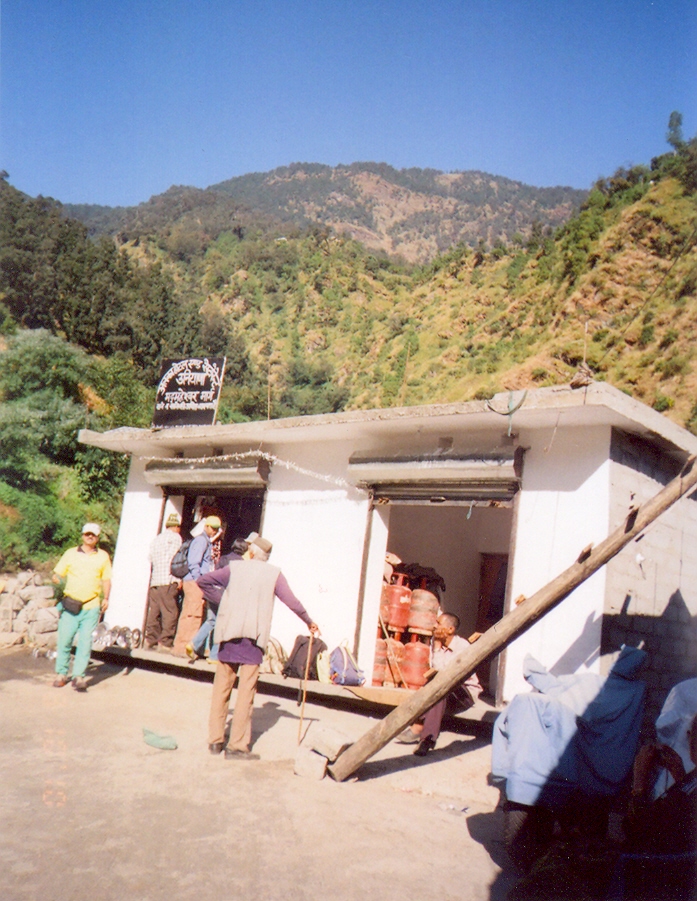
The entire place consisted of two large single storey buildings
that housed about 4 shops. The shops sold anything and everything
you can imagine. They were restaurants, stationery stores,
groceries and cosmetic stores all bundled up. Steep mountains covered with lush
verdure rose immediately behind the shops, and reached up to the
blue sky.
 Uniana Uniana
[Image loading...]
 [Click on the camera icon to hide the photo.]
We were to have our breakfast in one of the little shops. Chapati
was being prepared. And vegetables. Potatoes and eggplants
(brinjals) still in their jackets were being boiled in a pressure
cooker. Everything were managed by a couple, apparently the
owners of the shop. We were in a hurry to start. So Tublu-da and
Ballu lent helping hands to peel the potatoes.
Now it is time to fry the boiled the vegetables. No
khunti
was at hand, so the cook would grab the frying pan with his hands
and give at an occasional shake. Pungent yet appetising smoke is
filling the inside of the little shop.
The food was delicious. And after a hearty meal we started on our
trek at 9:20.
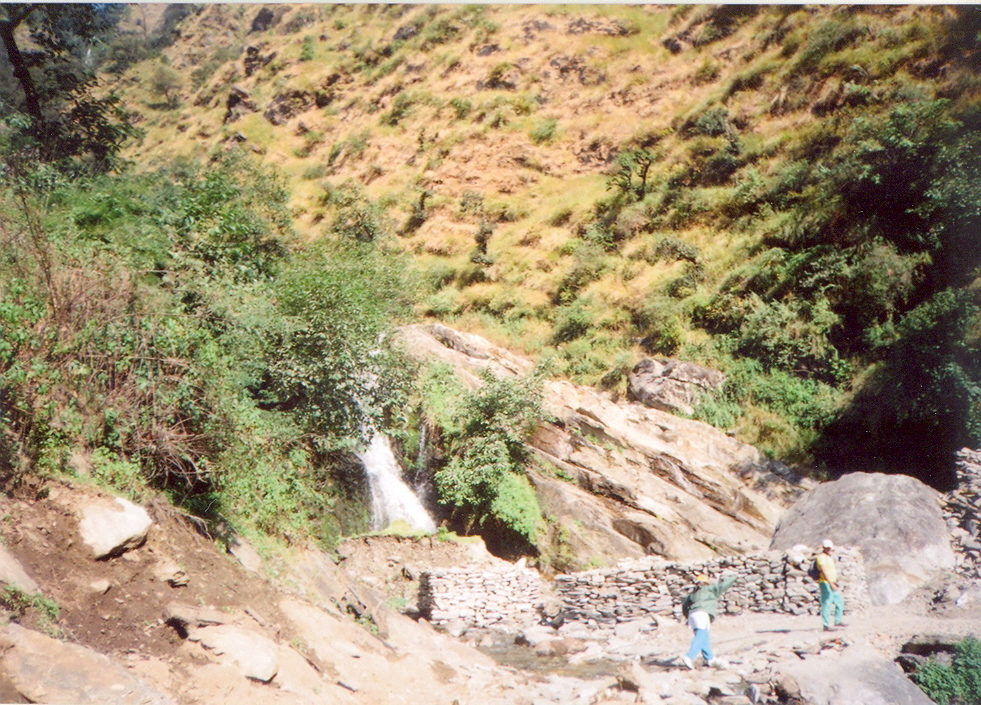
We start
[Image loading...]
 [Click on the camera icon to hide the photo.]
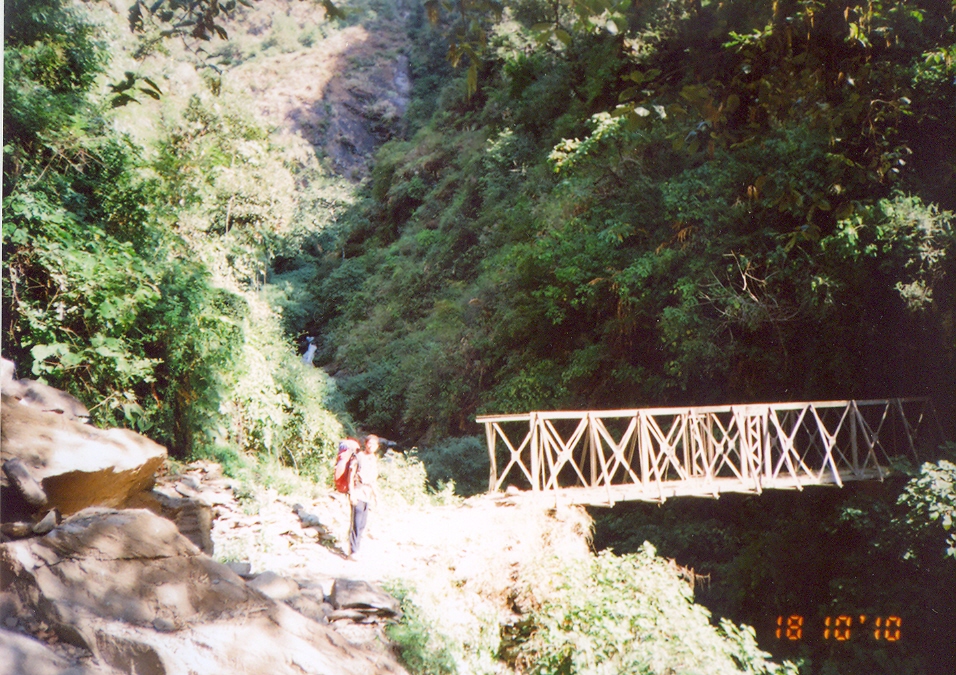
A little bridge
[Image loading...]
 [Click on the camera icon to hide the photo.]
The first twenty five minutes we walked on motorable road that
snaked its way from Uniana towards a little village called
Ransi. The road is still being constructed. On the left we see a
mountain go up. On the right the mountain continues downwards.
Large steps are sculpted down the slope to allow
production of Ramdana (a local course variety of wheat with
reddish stalks). Overhead wires are smartly coming up from the
depth of the slope and vanishing beyond the next mountain. I can
see some banana trees over there. A little stream of water
trickling down the slope greeted my feet. It is quite sunny and
warm. So I do not care if my shoes get wet now.
9:45am. Our trek route begins as we head down a slope. Ah, the
familiar feeling of rough stones under my feet. There is
shrubbery aplenty, but unlike the Himalayas in north Bengal here
I do not see many ferns.
The shrubbery soon gave way to tall trees providing little
shadow. The strong sunlight is warm but not scorching. I feel the
first drops of perspiration accumulate on my forehead.
There goes Madmaheshwar Ganga deep down in the valley under my
feet. I am walking more or less horizontally along the slope of a
mountain. The river (or, rather, the turbulent mountain stream)
is flowing at the very bottom of the slope. Immediately on her
other side the terrain rises again to another lofty height
covered with forests. My route is approximately horizontal, but
actually with each each step the trail coming down closer to the
babbling brook. I hear the babbling distinctly even now from my
height. It is like deep rumble that is accompanied by incessant
chirping of crickets.
10:05am. I meet three local people carrying a large corrugated
sheet of tin. These people own an inn in the village of Ransi
that our trail will pass by.
10:15am. Our mules overtook us. The mules always start late, and
walking in a fast ambling pace overtake the trekkers soon.
What are the most commonly encountered experiences during trekking in
the Himalayas? Is it the low temperature? Or the mountain streams
rolling down every corner? Or the tiny little bridges strewn all
over the place? Or the mules and cattle with jingling bells
round their necks? Yes, you meet all these during a trek. But
what you meet even more frequently are gangs of fellow trekkers
who are all from the vicinities of Kolkata. You meet fatty, Bengali
housewives trudging up in sarees, their forehead smeared with
vermilion soaked in perspiration. You will find granddads
from Salt Lake walking with sticks. And of course you are sure to
find many members of the younger generation, either sex, some
conceited, some eager to share their experience with a broad
grin. There are the coy girls in jeans and tees who would never
look you straight in the face. But a typical Bengali
young man with a flabby tummy bulging under a half-buttoned
shirt is all smiles. He is eager to give you a list of all the
treks he has done so far. Then there are the bird watchers with a
elaborate cameras dangling on their chests. They try to look a
class apart as they monitor the sky with their noses sticking up in the air, somewhat
disdainful of the ordinary trekkers who "merely walk up and down
the hills aimlessly".
At 10:30 I overtook just one such trekking group hailing from
Dankuni.
I am passing very close to a plot of Ramdana. I am now alone.
All my fellow trekkers are behind me. This gives a vague
(and silly) sensation of being a pioneer.
I see a blue house to my left. There are two little shops in
it. This is the village of Ransi. A small but important village
in this area.
Mountain streams that gush down in the monsoons carve their own
courses down the mountain sides. These are are veritable
obstacles when building trek trails. Smaller streams are allowed
to trickle over the trail creating muddy and slippery
patches. More turbulent ones must be allowed flow under
the trail through specially constructed channels. Every now and
then these channels erode away causing the trail above to
collapse. Mending these is an ever-continuing process in the
Himalayas. At around 10:40 I came across such a repair work. The
damaged trail here is temporarily replaced by a makeshift bridge
of loose stones balanced on an iron beam.
The trail has its ups and downs, but it is generally going
down. Madmaheshwar Ganga is coming closer and closer. From my
height I can now
distinctly make out the flow in the river.
At 10:50 the trail bifurcated. The branch going upwards led into
a rocky path, while the downwards branch looked more
docile. Judging by the mule droppings, the latter path seemed to
be the one more frequented. But the place was absolutely
desolate. So I thought it better to wait until some knowledgeable
person turned up. It was as good an excuse as any to stand and
stare at the gorgeous beauty around me. Just beside the trail was
a shrub bearing some bright yellow fruits contrasting nicely
against the azure sky above. What is the most enchanting feature
about the wide vista that rolls before my eyes? The mountains?
The murmuring brook? The meandering trail? The glorious white
peaks framed against the sky? No, none of these alone accounts
for the mesmerising feeling. This feeling, in my opinion, comes
from the fact that my sight can wander everywhere
unobstructed. This sense of being part of an infinite whole is
possibly the most cherished sensation that I get in a trek.
The first man to pop up from behind the turning over there was
none other than our faithful Ballu. Guided by him I descended
the down the lower branch of the trail.
About an hour later the trail bifurcated again. But this time the
correct branch was clearly marked with stones. So I could proceed
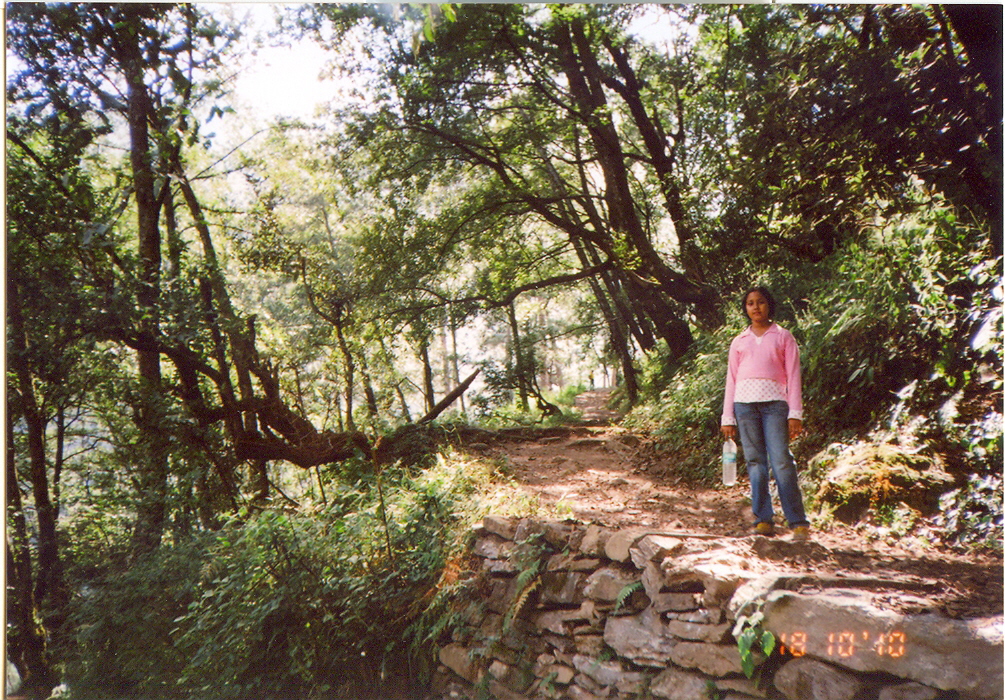
without delay. I am now passing through a forest. The broad
daylight notwithstanding, the sylvan chequer work of light and
shade makes interesting patterns. Most of the trees are very
tall, with a thick layer of moss dangling all over
them. Nandita-di, the biology teacher, later told be that there
are many pine trees of the species Pinus Khasiana
here. Their barks are a mosaic of square tiles. The leaves are
very thin, dangling in a bunch like strings. Incessant chirping of
crickets fills the air, which is remarkably free of any sound of
birds. Apart from the chirping and the deep rumbling of
Madmaheshwar Ganga (which is now hidden from my view) the only
other sound that greets my ears is that of my own breathing.
Up there in the vast sky a lone eagle is doing
rounds...gliding noiselessly, barely flapping its wings. This,
however, is not the sole representative of the local fauna. There are
the innumerably many lizards. The warm weather is the ideal
condition for these cold-blooded reptiles to bustle in. And this
they were doing merrily all the time. Thick-skinned, dark brown
in hue, the lizards were sunbathing on stones. Look at them, and
they would fearlessly look back at you. Go too close, and they
would immediately slip into a crevice.
At 11:35 the trail turned sharply downwards. Going
down the rapidly descending trail was like
cascading down a stream.
Near the bottom of the descent I saw a little house tucked neatly
in a nook. The others were some distance behind, so I planned to explore it
a bit. The house is beautifully situated. Its V-shaped roof
covered both the house as well as an adjoining veranda. A
structure that looked like a well was nearby. A neatly maintained
trail led to the house. A dream house, it seemed to me. Nobody
was in. The door was locked. Some pine cones lay strewn
around. Some shrubs nearby were bright with yellow flowers.
While I was busy inspecting this house, some of my trek mates
caught up from behind. At 11:50 we noticed a sign painted on the
road side mountain saying that Gondar is 3.5km ahead. In fact,
Gondar is visible from here. But neither the sight of the village
nor its distance could give us an idea about how much time we
shall need to get there. In these hilly terrains, it is steepness
more than the distance
that determines the time to reach a destination.
On our way to Gondar
[Image loading...]
 [Click on the camera icon to hide the photo.]
12:00. I can see a white peak. I do not know its name.
Within ten minutes the trail has entered a shadowy region. The
mountain on the other side of the river is standing like a bright
sunlit wall. I feel a a bit cold in the shade. The Gondar village
is at a slightly higher altitude than where we are now. A little
10 minute walk up a gently sloping trail followed by a steeper
for the next 15 minutes took us to the same
level as the village. And it was at 12:55pm that Ballu and I
entered the village of Gondar.
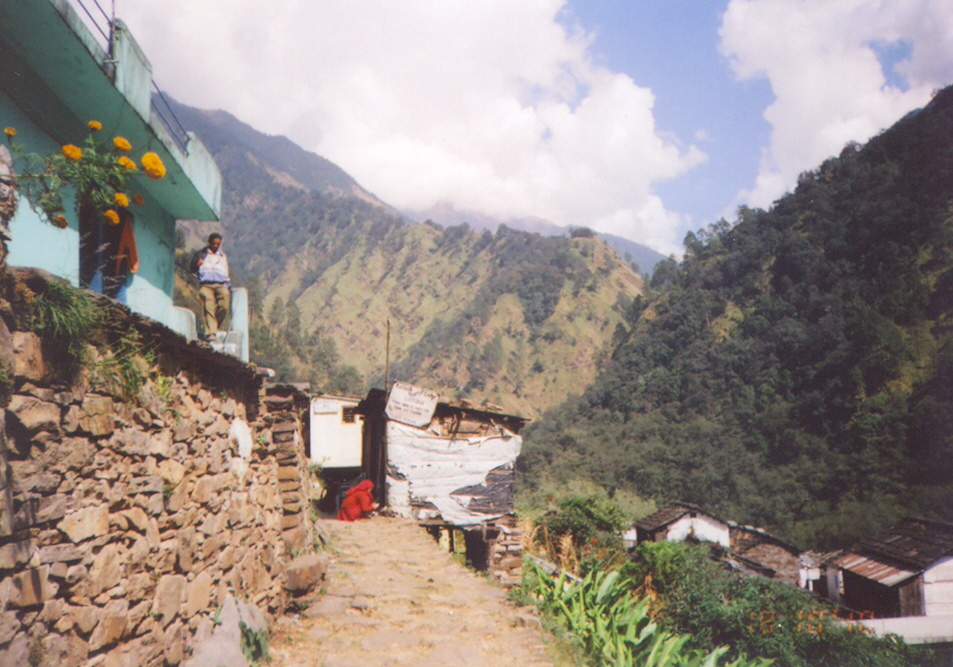
Gondar as we enter it
[Image loading...]
 [Click on the camera icon to hide the photo.]
The village of Gondar is situated on the bank of Madmaheshwar
Ganga. Consisting of about 30 houses, it deserves to be called a
village of repectable size in these hilly areas. About five of
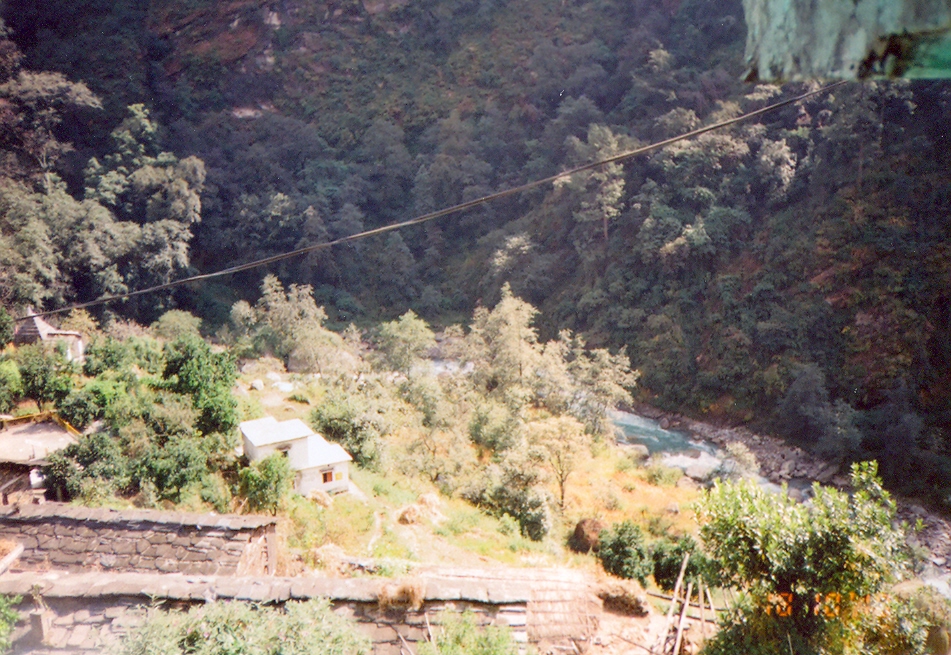
the 30 houses are of concrete. Perched atop a two storey building
(the highest point in the village) I can see Madmaheshwar
Ganga gurgling down at a distance.
View from the building top at Gondar
[Image loading...]
 [Click on the camera icon to hide the photo.]
There is no electricity here
save what comes from the solar panels strewn here and there. I am
not sure how much electrical energy one gets from the sun, but
the burning hot stone under my feet is giving off enough heat energy.
The entire village is contained in the lap of green mountains.
A rough staircase constructed out of stones leads into the
village. A brief walk down this revealed some common village sights:
cows dozing, children playing, men repairing mud walls. There is
a school (up to class eight) in this village. Students from
nearby villages come here to study.
Chandra Pal arrived at Gondar at 1:25pm. All the rest except
Dipu-da escorting the
elderly couple were in by 1:50. These three made their entrance
at 2:30pm.
In the meantime we had finished our lunch (khichuri and ghee). I headed off for
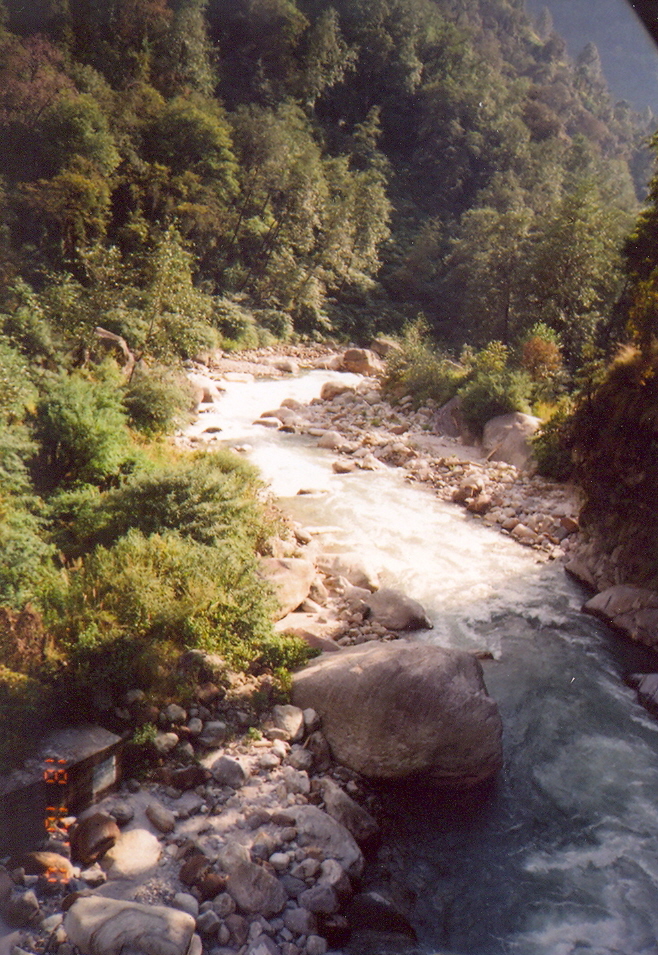
Khatara at 2:45. The next twenty minutes found me walking
merrily downwards until I came to a bridge situated in an
exquisite position. It was across a tributary to Madmaheshwar
Ganga. The confluence of the two streams was near at hand. Nearby
was a dilapidated villa once owned by Umaprasad Mukhopadhyay.
View from the bridge near
Umaprasad Mukhopadhyay's villa
[Image loading...]
 [Click on the camera icon to hide the photo.]
The trail started climbing up after the bridge. For the next hour
it continued its upward slope. Some trekkers from Howrah were on
their way back. One of them had a sprained ankle, so they had to
go really slowly.
The sky that has been beaming all along so far is now getting
overcast with cloud. With the sun hidden behind a veil of cloud,
the surroundings are bathed in a surreal illumination. But
Chandra Pal who has caught up with me finds nothing interesting
in it. His sole attention is devoted to his mobile phone. He is
checking every now then if it "gets a tower" (which it
doesn't). When we finally arrived at Khatara at 4:05 I was
thankful to be ridden of his incessant chattering about petty family affairs.
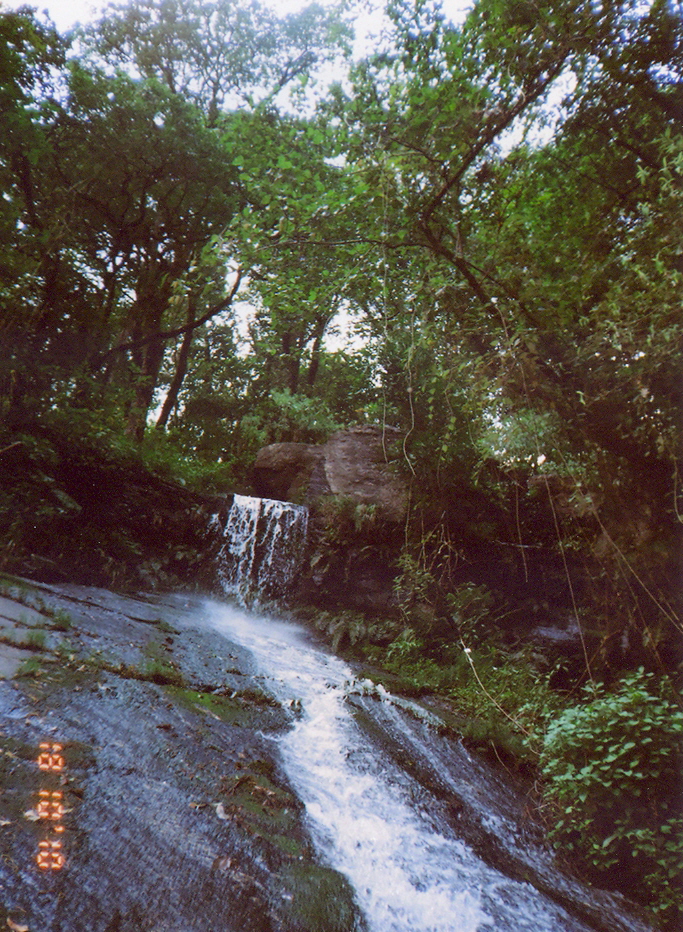
A wayside waterfall
[Image loading...]
 [Click on the camera icon to hide the photo.]
Up to Gondar I was full of enthusiasm. But this one hour climb
from Gondar to Khatara has exhausted me to some extent. The
others arrived between 5:30 and 6:00.
Khatara is a small village that consists apparently of just two
or three households and a government forest cottage (that remains
closed most of the times). The place where we put up for the
night belongs to one of the households. Two cottages built of
stone and thatched with all sorts of things (tins, straws and
even some ropes made of magnetic cassette tapes!). Indeed, ropes
made by twining cassette tapes seem to be in common use here. One
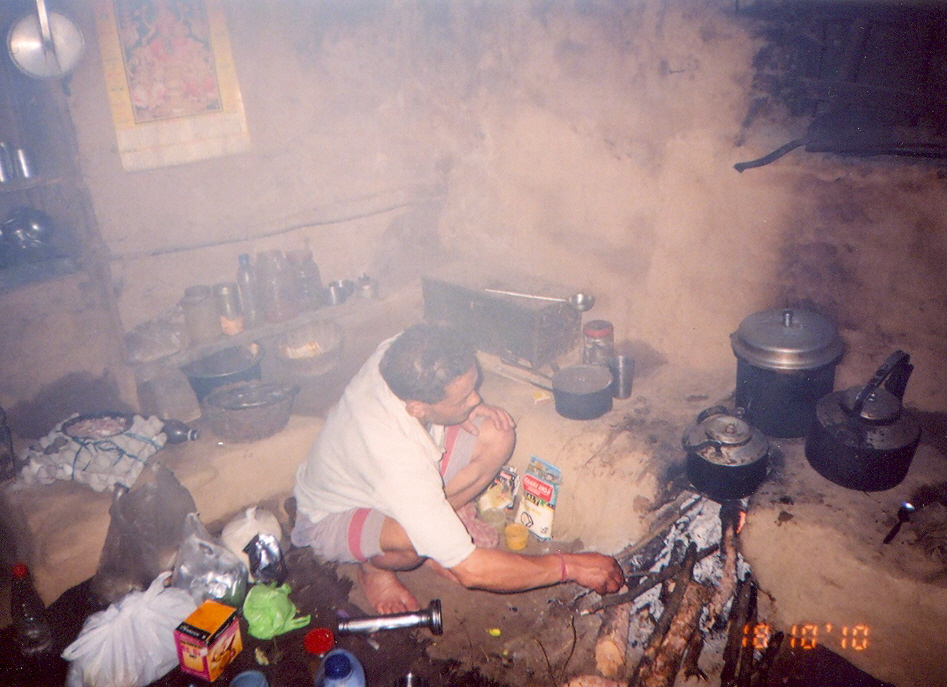
of the cottages is used as a large kitchen (this is also used as the
sitting room thanks to the warmth). Indeed the warmth was too
endearing to let us complain about the choking fume rising from
the wood fire.
Inside the kitchen at Khatara
[Image loading...]
 [Click on the camera icon to hide the photo.]
The other cottage is a larger one that is partitioned into two
dark compartments used as bedrooms. Half of the rooms were filled
with raised platforms that served as beds. There were thick
blankets full of bedbugs that made a sumptuous repast on our
flesh and blood during the night, the only night during the trek
when even a sound sleeper like myself had trouble sleeping.
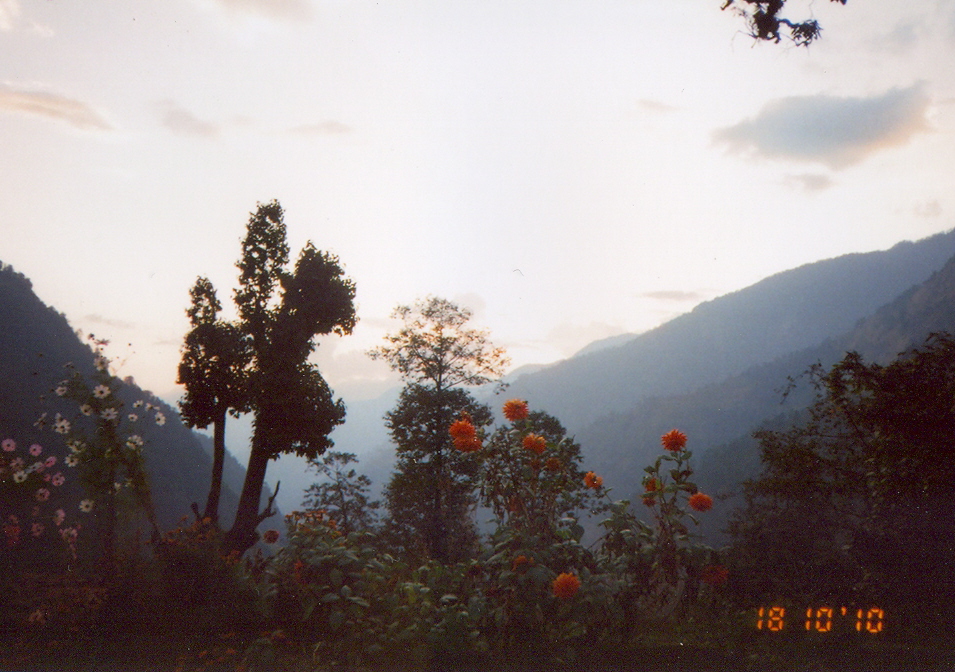
The two cottages were at right angles to each other, fondly
holding between them a little garden with many brightly coloured
flowers. The mules that were tethered close by evinced their
appreciation for the floral beauty by munching off the
flowers. The householders seemed quite content with it, for
nobody complained.
The little garden at Khatara
[Image loading...]
 [Click on the camera icon to hide the photo.]
On one side of the garden was a little plot (barely larger than a
badminton court) growing ramdana. This reddish patch of
serves as a landmark visible from afar. Beyond this point the
ground falls steeply down out of sight towards Madmaheshwar
Ganga, which is not visible from my present position.
The clouds accumulating in the sky do not bode good for our trek
tomorrow, but they are weaving mesmerising patterns in the glow
of the
setting sun.
There is my rucksack leaning limply on the ramshackle bench in
from the bedroom cottage. And here am I slouched no less limply
on the kitchen floor sucking up the warmth of the hearth with all
my body as best as I can.
Then I got up to have a walk around and see the other
households. Two little girls, apparently siblings, were playing
nearby. A smile was all the effort on my part to secure an
invitation for tea at their place. I am not fond of tea, but for
once I readily agreed. A superannuated lady with a face
wizened as raisin sat on their veranda peeling rajma. There were
three girls in the family, all except the eldest going to school
at Gondar. The eldest had finished her class eight, the highest
class in the
school at Gondar. I
picked up a class
notebook lying on the floor. It contained
a English poem, some geography and some mathematics, all written
in the unsteady handwriting of a child. The owner of the
copybook, who happened to be none other than the little girl who
had invited me, was in a great flurry to hide herself (and then
to peep out in curiosity) when she saw me leafing through her
notes. "I do not like English or mathematics", she whispered in
Hindi, "I like Hindi."
I returned to our cottage. After the day's trek I find myself
walking with a heavy gait. It is difficult to get mobile
connection from here. The local people has figured out an
interesting way to improve upon the chance of mobile
connectivity. They would hold their mobile sets as high as above
their head as possible with extended hands. Then they would yell
at the phone from below. I doubt the benefit of the little extra
height gained like this, but it surely makes an interesting
sight.
Dinner was served at 9:00, then we all went to sleep at 9:45.
|