The definition is simple: First, it is a function that takes as its
input some vectors (may belong to different vector spaces), and
produces a vector as its output. Also, if you fix all but one of
the input vectors, then the function is linear in the remaining
input vector. A simple example is:
$f:{\mathbb R}^2\times{\mathbb R}^3\rightarrow {\mathbb R}^2$ given by $f(\v u, \v v) =
(u_1(v_2+3v_3), u_2v_1).$
A multilinear map that takes only one input is called a linear
map, and those that take two inputs are called bilinear
maps.
We shall work with the bilinear case (the general case is
similar).
The answer is: The most general form of a bilinear map
from ${\mathbb R}^m\times{\mathbb R}^n$ to ${\mathbb R}^k$ is
$$
f(\v u,\v v) = \sum_{i=1}^m \sum_{j=1}^n \v a_{ij} u_i v_j,
$$
where $\v a_{ij}$'s are any arbitrary vectors in ${\mathbb R}^k.$
Let's see why.
Clearly, it is a bilinear map. To see that this is the most
general form, start with any bilinear map $g:{\mathbb R}^m\times {\mathbb R}^n\rightarrow {\mathbb R}^k.$
Let $\{\v e_1,...,\v e_m\}$ be the Euclidean basis
for ${\mathbb R}^m$ and let $\{\v E_1,...,\v E_n\}$ be the
Euclidean basis for ${\mathbb R}^n.$
Define $\v a_{ij} = g(\v e_i,\v E_j)\in{\mathbb R}^k.$
Then, by bilinearity of $g,$ we have for any $\v
u\in{\mathbb R}^m$ and any $\v v\in{\mathbb R}^n$
$$
g(\v u,\v v) = g\left(\sum_i u_i \v e_i, \sum_j v_j \v E_j\right) =
\sum_i\sum_j u_i v_j g(\v e_i,\v E_j) = \sum_i\sum_j \v a_{ij}u_i v_j,
$$
as required.
But there is a little
unexpected snag here. We are used to thinking ${\mathbb R}\times{\mathbb R}$
as "essentially same" as ${\mathbb R}^2.$ For multilinear maps,
however, they are quite different.
Consider, for example, the map $f:{\mathbb R}\times{\mathbb R}\times {\mathbb R}\rightarrow{\mathbb R}$
defined by $f(x,y,z) = xyz.$ Is this multilinear? The answer is is
yes: hold $y,z$ fixed, then $x\mapsto xyz$ is linear
in $x.$ Again, if you hold $x,z$ fixed, then $y\mapsto
xyz$ is linear in $y.$ Similarly, for fixed $x,y$
the map $z\mapsto xyz$ if linear in $z.$
Now consider $g:{\mathbb R}^2\times{\mathbb R}\rightarrow{\mathbb R}$ as $g(\v x,y) = x_1x_2y.$
Is this map multilinear? Unfortunately, no! Fix $y.$ Then
the map $\v x\mapsto x_1x_2y$ is not linear.
We shall define a thing called a tensor product of a
vector in $\v u\in {\mathbb R}^m$ and a vector $\v v\in{\mathbb R}^n.$
The definition is simple
$$
\v u\tp \v v = \left[\begin{array}{ccccccccccc}u_1\\\vdots\\u_m
\end{array}\right]\left[\begin{array}{ccccccccccc}v_1 & \cdots &
v_n
\end{array}\right] = \left[\begin{array}{ccccccccccc}
u_1v_1 & u_1v_2 &\cdots & u_1 v_n\\
u_2v_1 & u_2v_2 &\cdots & u_2 v_n\\
\vdots\\
u_mv_1 & u_mv_2 &\cdots & u_m v_n
\end{array}\right].
$$
The result is an $m\times n$ matrix with real entries. If we
denote the space of of all $m\times n$ real matrices
by ${\mathbb R}^{m\times n},$ then you can think of tensor product
as a function
$$
\tp:{\mathbb R}^m\times{\mathbb R}^n\rightarrow {\mathbb R}^{m\times n}.
$$
Notice that this map is neither one-one nor onto. (Show this
quickly!) Also observe that this map is bilinear.
We shall also use the notation ${\mathbb R}^m\tp {\mathbb R}^n$
for ${\mathbb R}^{m\times n}.$ Thus, the notation $\tp$ is now
doing double duty: as a product between vectors, and also as
product between vector spaces.
We can play the same game with more than 2 vectors. For example,
suppose we take $\v u\in{\mathbb R}^2$, $\v v\in{\mathbb R}^3$
and $\v w\in{\mathbb R}^2.$
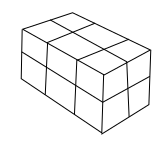
Then $\v u\tp\v v\tp\v w$ is going to be a "3D matrix" of
shape $2\times3\times2:$
A "3D matrix"
It has $2\times3\times2 = 12$ entries of the form
form $a_{ijk},$ where
$$
a_{ijk} = u_iv_j w_k
$$
for $i\in\{1,2\},~j\in\{1,2,3\},~k\in\{1,2\}.$
As you can guess, the space of all "3D matrices" of this shape
will be denoted by ${\mathbb R}^2\tp{\mathbb R}^3\tp{\mathbb R}^2.$ So in this
example
$$
\tp:{\mathbb R}^2\times{\mathbb R}^3\times{\mathbb R}^2\rightarrow{\mathbb R}^2\tp{\mathbb R}^3\tp{\mathbb R}^2.
$$
Again, it is not one-one or onto, but it is multilinear.
The generalisation to tensor product of any finite number of
vectors is straightforward now.
The way we defined tensor product suffers from two problems. It
is difficult to express/visualise "higher dimensional
matrices". Also we would like to have a result like
associativity:
$$
(\v u\tp \v v) \tp \v w = \v u\tp (\v v \tp \v w).
$$
Unfortunately, in our present formulation neither the LHS nor the
RHS makes any sense, because we have defined $\tp$ as a
function that takes vectors as inputs and produces "higher order
matrices" as outputs. So $(\v u\tp \v v)$ is a matrix, and
hence cannot be fed into the input of the next $\tp.$ So we
want to express the same definition is a somewhat neater way so
that $\tp$ takes two vectors as input and produces
a vector as output. This is easy to visualise: just unwrap
a $2\times 3$ matrix as a list of $6$ numbers. This
unwrapping, unfortunately, can be done in lots of different ways
(row-by-row, column-by-column, zigzag fashion etc). All the
methods are essentially equivalent, but mixing them up would lead
to absurd results. The problem would become even more serious for
"higher order matrices".
So we shall express the same idea in a different way.
Let's take a look at $\v u\tp \v v$ where $\v
u\in{\mathbb R}^2$ and $\v v\in{\mathbb R}^3.$ It was a bilinear
map. But something more is true. In order to appreciate this
think as follows.
What are the most basic bilinear maps that you can think in
terms of $(u_1, u_2)$ and $(v_1, v_2, v_3)?$ The answer
is: there are 6 of them: $u_1v_1$, $u_1v_2$,...,$u_2v_3.$
All other bilinear maps can be made by combining them, for
example $2u_1v_1-5u_2v_3.$ Now notice that these basic
bilinear maps were precisely the entries of the matrix $\v u\tp\v v.$
This observation leads to a neat way to express tensor products:
it is the most basic bilinear map, in the sense that any other
bilinear map may be constructed out of it.
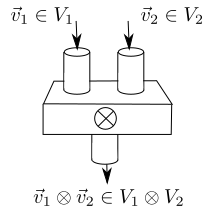
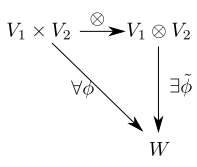
Let's write out this idea step by step. Our aim is to
express $\tp$ as a function that takes two vectors and
produces some vector. We shall avoid explicit representation of
the vectors (as any representation would involve some arbitrary
choice of arrangement, row-by-row, column-by-column etc, that we
want to avoid).
What we want
Step 0: Start with any two vector spaces $V_1$
and $V_2$ (over the same field, of course). Our plan is to
define tensor product in both the senses: tensor product of two
vector spaces as well as tensor product of two vectors.
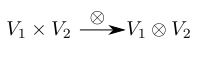
Step 1: We define a tensor product of $V_1$
and $V_2$ as a vector space $V_1\tp V_2$ and the tensor
product of vectors as a bilinear map
from $V_1\times V_2$ to $ V_1\tp V_2:$
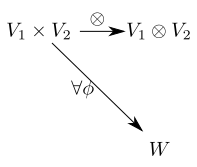
Step 2: This must be the most basic bilinear map possible,
i.e., if you give me any bilinear map $\phi$ from $V_1\times
V_2$ to any $W,$
then I can construct your
bilinear map using my bilinear map (the tensor product):
$$
\phi(\v v_1,\v v_2) = \tilde\phi(\v v_1\tp \v v_2)
$$
for some $\tilde\phi:V\rightarrow W.$
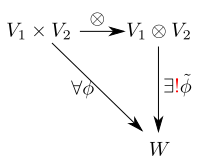
Step 3: I want tensor product to be just this and nothing
else. So we want the $\tilde\phi$ to be unique.
What is the tensor product of ${\mathbb R}$ with itself? The answer
is ${\mathbb R}$ itself! Also for $a,b\in{\mathbb R}$ we have $a\tp b = ab.$
Let's prove this from the neat definition. First, this
map $(a,b)\rightarrow ab$ is bilinear. Next, take any bilinear map
from ${\mathbb R}\times{\mathbb R}$ to any ${\mathbb R}^n.$ It must look like
$$
(a,b)\mapsto ab\v v
$$
for some $\v v\in{\mathbb R}^n.$ So taking $\tilde\phi(x) = x\v v$
will work.
This is a product between two vectors from the same vector
space. If $\v u,\v v\in{\mathbb R}^n$ then $\v u\wedge \v v = \v u\v v' - \v v\v u'.$
For example,
$$
\left[\begin{array}{ccccccccccc}1\\2
\end{array}\right]\wedge\left[\begin{array}{ccccccccccc}3\\4
\end{array}\right] = \left[\begin{array}{ccccccccccc}1\\2
\end{array}\right]\left[\begin{array}{ccccccccccc}3 &
4
\end{array}\right]- \left[\begin{array}{ccccccccccc}3\\4
\end{array}\right]\left[\begin{array}{ccccccccccc}1 & 2
\end{array}\right]= \left[\begin{array}{ccccccccccc}0 & -2\\2 & 0
\end{array}\right].
$$
Notice that this is a skew-symmetric matrix. A skew-symmetric
matrix of order $n$ has $\frac{n(n-1)}{2}$ "free" entries
(any triangular half). This motivates us to
define ${\mathbb R}^n\wedge{\mathbb R}^n$ as ${\mathbb R}^{\frac{n(n-1)}{2}}.$
It is easy to see that the wedge product is bilinear and
alternating (i.e., $\v u\wedge\v v = -\v v\wedge\v u$).
Just as for tensor product, here also we notice that the entries
in the wedge
product matrix are the most basic bilinear alternating
functions. We utilise this is to give a neat definition of wedge
product.
Step 0: Start with some vector space $V.$ We shall
define $\wedge:V\times V\rightarrow W$ for some suitable vector
space $W.$
Step 1: It must be a bilinear, alternating map.
Step 2: Given any bilinear, alternating map $\phi$
from $V\times V$ to any vector space $U,$ we can
express $\phi$ in terms of the wedge product:
$$
\phi(\v u, \v v) = \tilde\phi(\v u\wedge\v v).
$$
Step 3:This $\tilde\phi$ should be unique for each $\phi.$
Comments
To post an anonymous comment, click on the "Name" field. This
will bring up an option saying "I'd rather post as a guest."