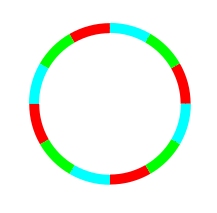
Let $\Omega$ be the following circle (only the circumference, not the
inside). Let the circumference have length 1.
A circle
If I pick a point "at random" from this circle, what is the
chance that it lands in the upper semicircle? The obvious answer
is $\frac 12.$ What is the chance that it would land in any
given quadrant? The obvious answer this time is $\frac 14.$
In fact, for any arc, the probability equals the length of the arc.
Also, suppose that $A$ is some subset of the
circle. Let us denote by $A+\theta$ the subset obtained by
rotating $A$ by an angle $\theta.$ Which subset has the
larger probability, $A$ or $A+\theta?$ Since we are
picking the point "at random" without any bias for any particular
direction, hence both $A$ and $A+\theta$ should have
the same probability.
It might come as a surprise
that there is no probability function $P$ from the power set
of $\Omega$ to ${\mathbb R}$ that satisfies these two
conditions simultaneously, i.e.,
for any arc $A$ we must have $P(A)=length(A).$
for any $A\subseteq\Omega$ and for any $\theta$ we must
have $P(A) = P(A+\theta).$
Thus, we are claiming that we cannot have a function $P$
definied on the entire power set of $\Omega$ that satisfies
the three probability axioms as well as these two extra conditions.
We shall provide a quick proof of
this here by contradiction. Let, if posible, there be such a
function $P.$ We shall demonstrate a "bad" set $M$ for
which $P(M)$ cannot be defined, contradicting the assumption
that $P$ is defined for all subsets of $\Omega.$
So in this scenario, we have
to leave out "bad" sets like this from $\ev.$ However,
all subsets that we shall ever need for practical pursposes are
still in $\ev.$ That is why, this technical point may safely
be ignored during a first course on probability.
Now for the proof. Let's warm up first.
Imagine the circle split up into
12 equal parts like the face of the clock.
Split up into 12 arcs
We have grouped the arcs into 3 different groups of size 4 each
(shown by the colours red, green and blue). The grouping is done
like this: Give any colour to any arc to start with. Then start
counting clockwise and use the
same colour to every 3rd arc. Then pick an uncoloured arc and
proceed similarly with another colour, and so on. Notice that the
parts of the different colours are all identical in shape and
size. One is just a rotated version of another. So the total
length of all the parts must be the same.
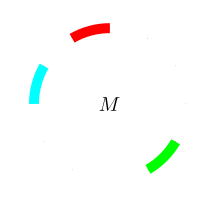
One arc of each colour
Now pick any one arc of each colour. This gives you a set. Call
it $M.$ Rotate $M$
by $90^\circ$ clockwise. The new set is $M+90^\circ.$
Then, notice that $M,
M+90^\circ, M+180^\circ$ and $M+270^\circ$ are all disjoint and build up
the entire circle.
Partitioning the circle
Well, that's all the warm up we need! Now for the actual thing.
We again start with the circle, whose
circumference is 1. Also, for two points $x,y\in
S$, we shall denote the (shorter) arc length between them
by $|xy|.$ This will always be in $[0,1/2].$
Pick any point on the circle, colour
it red. Also mark all points that are at a rational distance from
this point with the same colour. Now pick a point that has not
been coloured. Colour it green, and do the same thing again: mark
all points at a rational distance from it with green. Continue
like this until all the points are coloured. Of course, this will
take infinite amount of time. What we mean mathematically, is
that for each point $x\in S$ we define
$$
A_x = \{p\in S~:~ |px|\in{\mathbb Q}\}.
$$
Note the following points:
If $y\in A_x$ then $x\in A_y.$ So all
the $A_x$'s are not distinct. For example, if $x,y$
are diametrically opposite each other, then $A_x=A_y.$
Each $A_x$ is countable, since there are only countably
many rationals.
There are uncountably many distinct $A_x$'s (since
total number of points on the circle is uncountable).
Now pick exactly one point from each distinct $A_x.$ Call the set
of all these picked points $M.$
This is a troublesome set. I claim that you cannot define its
probability $P(M).$
For any rational number $r\in [0,1)$ we denote
by $M+r$ the set $M$ rotated clockwise by distance $r.$
Then note that
If $r\neq s$ are two rational points in $[0,1)$
then $M+r$ and $M+s$ are disjoint.
Let $\{r_1,r_2,...\}$ be a listing all rationals
in $[0,1).$
Then
$$
\cup_{i=1}^\infty (M+r_i)
$$
equals the entire circle.
Now, let's say that $M$ has $P(M)=\ell.$
Clearly, $\forall r\in[0,1)$ we must have $P(M+r)=\ell,$
as well.
Now, if $\ell = 0$ then the second
condition above implies that $P(\Omega)$
is $0+0+\cdots = 0,$ which is wrong, since length
of $P(\Omega)$ must be 1.
If $\ell>0,$ then $P(\Omega)$ becomes $\ell+\ell+\cdots =
\infty,$ again a contradiction!
This completes the proof
But as you can see, such "bad" sets are pretty difficult to come
across. So ignoring them will never cause any problem during our
course.
Comments
To post an anonymous comment, click on the "Name" field. This
will bring up an option saying "I'd rather post as a guest."