Computer vision is an important application area for clustering. Here the computer eye is a camera and
we want to know about the "things" in its field of vision. This
aim is acheivwd by clustering the pixels: This pixel belongs to a
chair, that one to a table, and those belong to the background,
and so on. A common scenario is where a robot counts / arranges items on
a conveyer belt. Suppose that a manufacturing unit produces
rectangular sheets and dumps them haphazardly on a conveyer
belt. The belt passes under a suveilance camera which typically
sees something like this:
Here it is easy to see that there are 5 clusters, and hence 5
objects. Now suppose that the camera sees something like this:
Here there are only 4 clusters due to overlap. But still we can
understand that there are actually 5 objects, since each object
is known to be a rectangle. Utilising prior information about the
shape of clusters while clustering is what is
called model-based clustering. Thanks to this extra
information, we can handle overlapping clusters.
The math
There are different ways to capture the idea of "shape"
statistically. One possibility is to assume that a typical point
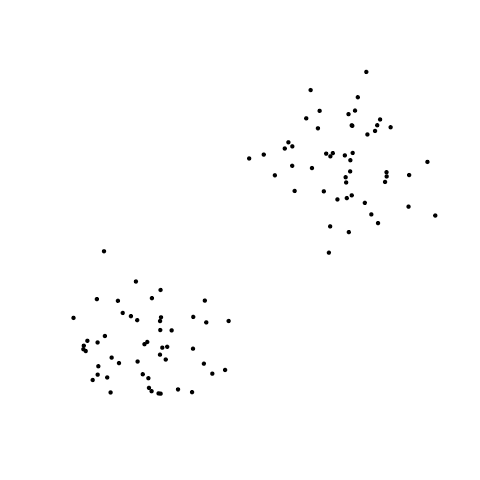
in the data set comes from a mixture distribution. Thus, a data
set that looks like this:
may be considered as coming from a mixture of two bivariate
normal distributions. We can visualise the following model:
God (or Nature, if you are an atheist!) has two bivariate
normal distributions up his sleeves.
He tosses a coin to pick on of them.
Then he generates (X,Y) from this distribution.
He repeats the entire exercise n times (each time
starting with a fresh toss of the same coin).
Finally he reports only the generates ( Xi , Yi
)'s, but not the outcomes of the tosses.
You only know the above scheme, but not the parameters involved
(the probability of head for the coin, or the parameters of the
bivariate normals).
In this case finding the mle is not computationally very easy. So
we employ the EM algorithm. We shall illustrate with a 1-dim
example, where everything is as above, except that God uses two
univariate Gaussian distributions. To simplify the exposition
further we shall assume that the variances are known, 1
and 1/4. Also we shall assume that the coin is unbiased.
Thus we have
Clearly, maximising this w.r.t. a,b is very
difficult. Instead, first pretend that God actually gave us the
outcomes of the coin tosses. Thus, our hypothetical data set
becomes
( Ti , Xi ), i=1,...,n,
where
Ti ∼ Bern(0.5)
and
Xi ∼ appropriate normal depending on value
of Ti. Now the likelihood function is
Lcomp (a,b) = 0.5n ∏1 φ(Xi - a) ∏2 φ(2(Xi - b)).
Here ∏1 is over all cases where the coin
showed Head and ∏2 is over the remaining
cases.
Taking log simplifies this considerably and prduces ℓcomp (a,b).
We would like to maximise this w.r.t. a,b, but
unfortunately we really cannot compute ℓcomp (a,b), as
God actually did not tell us the Ti's.
What we shall do is to take conditional expectation of
the ℓcomp (·,·) function given only
the Xi's, and maximise the conditional expectation.
Finding the conditional expectation is called the E-step,
and maximising it is called the M-step of the EM
algorithm.
The computation is pretty straightforward in our toy example, but
gets messy when we work in multivariate situation with unknown
variance matrices and more than two clusters.
The statistician can choose among a number of options trading
generality with computational simplicity:
cluster proportions known/unknown?
each cluster has same/different variance matrix?
are the variance matrix constrained to be of special form
(e.g., diagonal, compound symmetry etc)?