Suppose that we are given a multivariate data set, and we want to
fit an Archimedean copula to it. How to proceed? It depends on
how much you are assuming known about the copula.
Parametrically
If you assume a
known family with finitely many unknown parameters, then we can
apply MLE in the usual way. This is the parametric situation.
Nonparamtrically
If you have no idea about the funactionl form of the generator,
then are in the nonparamtric situation. Genest and Rivest in
their 1993 paper have outlined a procedure to
cope with this scenario. We briefly present the idea below.
We shall work with only bivariate case. So our data set is
( X1 , Y1 ) , ( X2 , Y2 ) , ... , ( Xn , Yn ) .
Also we shall assume that Xi's are iid Unif(0,1)
and Yi's are also iid Unif(0,1). If you have any
other marginal, just estimate them and "fold them back". Te the
joint cdf of ( Xi , Yi ) be C(x,y) which is an
Archimedean copula with generator φ.
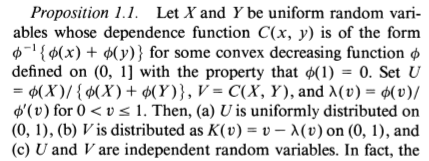
Genest and Rivest suggest a clever transformation of (X,Y)
to new variables (U,V) such that U has no
information about
φ (i.e., has no info about the copula)
while V has all the info about φ. Here is
Proposition 1.1 from their paper that gives this transformation:
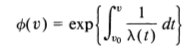
Notice that φ can be recovered from λ as follows.
The nonparametric estimation procedure is as follows:
estimate C(x,y) by the empirical cdf Cn (x,y) and
define Vi = Cn ( Xi , Yi ).
Estimate the cdf K by the empirical cdf of Vi's.
Find λ from K.
Find φ from λ.
For the details (as well a proof of the proposition) see the
paper linked above.