This follows easily once we show that
any generator is differentiable everywhere except at
countably many points.
The proof
depends on a geometric arguement. We shall need the following notation:
Suppose that we have a convex function
φ and two points x < y in its
domain. Then slope(x,y) will denote the slope of the chord
passing through the points (x,φ(x)) and (y,φ(y)).
We shall often need to compare slopes of two different
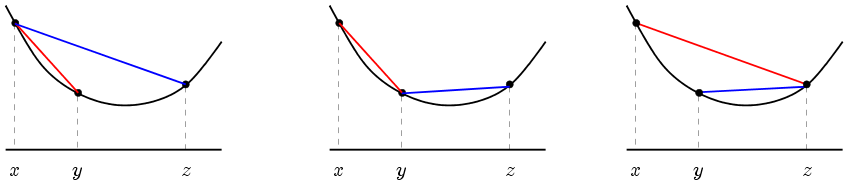
chords. All these comparisons will boil down to three fundamental
cases (for x < y < z):
Comparing slope(x,y) and slope(x,z),
Comparing slope(x,y) with slope(y,z),
Comparing slope(x,z) with slope(y,z),
The results of the comparisons are as follows. The proofs are
trivial and left as exercises.
Red slope ≤ blue slope in all three
cases
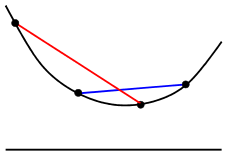
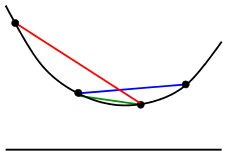
All other slope comparisons can be reduced to these. For example,
if we want to compare the slopes of the red and blue chords
below
we can simply imagine an intermediate chord (shown in green) as follows.
red ≤ green ≤ blue
Now we shall prove the following theorem which will imply that
any Archimedean copula has a density (w.r.t. Lebesgue measure).
Proof:
We shall proceed step by step.
Step 1: Shall show that for each c∈(a,b) the left hand
derivative f'-(c) exists.
Pick any x∈(a,c). Then slope(x,c) is an
increasing function in x.
Pick any y∈(c,b). Then slope(x,c) ≤
slope(c,y).
Thus slope(x,c) is a bounded increasing function,
and hence its limit exists as x→ c-.
Step 2: Using similar argument it follows that for each c∈(a,b) the right hand
derivative f'+(c) exists.
Step 3: Shall show that for any c∈(a,b) we
have f'-(c) ≤ f'+(c).
Pick any x∈ (a,c) and any y∈ (c,b).
Then slope(x,c) ≤ slope(c,y).
Taking limit as x→ c- and y→ c+ yields the
result.
Step 4: Shall show that for any c<d∈(a,b) we
have f'+(c) ≤ f'-(d).
Pick any x < y ∈ (c,d).
Then slope(c,x) ≤ slope(y,d).
Now take limit as x→ c+ and y→ d-.
Step 5: If for some c∈(a,b) the
function f'- is continuous at c, then shall show
that f'(c) exists.
Enough to show that f'-(c) = f'+(c).
We already have f'-(c) ≤ f'+(c).
Take any d∈ (c,b).
Then f'+(c) ≤ f'_(d).
So we have f'-(c) ≤ f'+(c)≤ f'_(d).
Let d→ c+. By the assumed continuity of f'-
at c, we have f'-(d)→ f'-(c).
So f'+(c)= f'-(c) by the sandwich law.
Step 6: Shall show that the function f'- is
nondecreasing.
Take any c < d∈ (a,b).
Then for any x∈(a,c) and any y∈(a,d) we have
slope(x,c) ≤ slope(y,d).
The result follows on taking limit as x→ c- and y→
d-.
Step 7: Since f'- is monotone, so it is continuous
everywhere on (a,b) except possibly on a countble set of
points. By step 5, f' exists at all points of continuity
of f'-.
Hence the theorem is proved.
[Q.E.D]