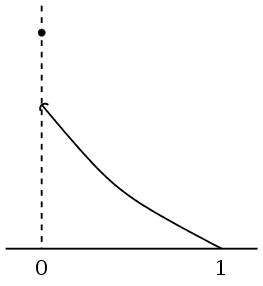
A discontinuous generator
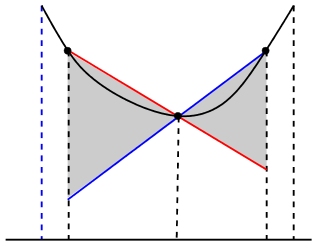
BLUE(t) ≤ φ(t) ≤ RED(t).Again, if you take t∈ (c,β) then
RED(t) ≤ φ(t) ≤ BLUE(t).Thus the graph of φ over [α,β] is sandwiched between RED and BLUE. As t→ c we have RED(t)→ φ(c) and BLUE(t)→ φ(c), because they are just continuous lines. So the sandwich law of limit implies that φ(t)→ φ(c), completing the proof. [Q.E.D] The above theorem gurantees continuity of a convex function in the interior of the domain. This forces any generator φ to be continuous on (0,1). Indeed, a convex function may be discontinuous at the end points as the following example shows.
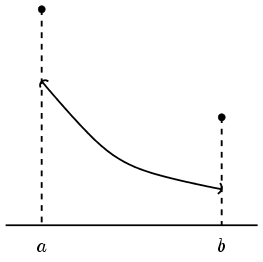
C(x,y) = φ[-1] ( φ(x)+φ(y) ) for x,y∈ [0,1].Shall show that C(x,y) is a copula. The proof will be done in three steps. In the first step is to show that satisfies the boundary conditions C(0,y)=C(x,0)=0 and C(1,y)=y and C(x,1)=x. All these are trivial from the definition of φ[-1] and are left as an excercise. Next we need to show that for any x1 < x2 ∈ [0,1] and any y1 < y2 ∈ [0,1] the function C(x,y) assigns a positive mass on the rectangle [ x1 , x2 ] × [ y1 , y2 ], i.e.,
C( x2 , y2 ) - C( x1 , y2 ) - C( x2 , y1 ) + C( x1 , y1 ) ≥ 0.We shall prove this first for a special case: y2 = 1. The general case will then follow easily. For the special case the inequality becomes
C( x2 , 1 ) - C( x1 , 1 ) - C( x2 , y1 ) + C( x1 , y1 ) ≥ 0,or, thanks to he first step above,
x2 - x1 - C( x2 , y1 ) + C( x1 , y1 ) ≥ 0.So in the second step we shall prove this. Since there is no y2 in the picture anymore, let's rename y1 to y. Then we are to show
C( x1 , y ) + C( x2 , y ) ≥ x1 - x2 .Let
a = φ( x1 ) , b = φ( x2 ) , c = φ( y ) .Now consider the points b ≤ a ≤ a+c:
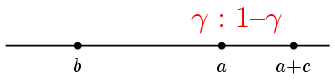
a = (1-γ) b + γ (a+c)then convince yourself that
γ = (a-b)/(a+c-b) .By interchanging the roles of γ and 1-γ we have the following picture:
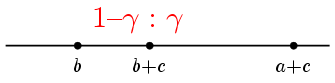
b+c = γ b + (1-γ) (a+c).Now apply φ[-1] to both sides of both these convex combinations. Since φ[-1] is a convex function, we have
φ[-1] (a) ≤ (1-γ) φ[-1] b + γ φ[-1] (a+c)and
φ[-1] (b+c) ≤ γ φ[-1] b + (1-γ) φ[-1] (a+c).Add these up to complete the second step. Recall that our aim was to prove
C( x2 , y2 ) - C( x1 , y2 ) - C( x2 , y1 ) + C( x1 , y1 ) ≥ 0for any x1 < x2 ∈ [0,1] and any y1 < y2 ∈ [0,1]. The second step proved this only for the special case y2=1. In the third step we shall prove it in general. First notice that if y1 = 0, then the result is easy. So assume that y1 > 0. Consider φ( y1 ) - φ( y2 ). Thanks to the continuity of φ over (0,1] we can find t∈[0,1] such that
φ( y1 ) - φ( y2 ) = φ(t).Carefully understand this. We are using intermediate value theorem here. Then
C(x2,y_1) = φ[-1] (φ(x2)+φ(y_1))=φ[-1] ( φ(x2) + φ(y2) + φ(t)) = C(C(x2,y_2),t).Similarly,
C(x1,y_1) = C(C(x1,y_2),t).So
C(x2,y_1) - C(x1,y_1) = C(C(x2,y_2),t) - C(C(x1,y_2),t) ≤ C(x2,y_2) - C(x1,y_2),using the special case done in step 2. This completes the proof that an Archimedean copula is indeed a copula.