Let φ:(0,1]→ [0,∞) be a strictly decreasing, convex, continuous function with
φ(1)=0.
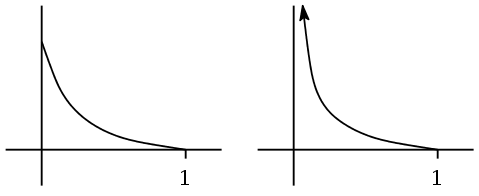
Two possible graphs look like:
We shall swap the two axes to define a new type of
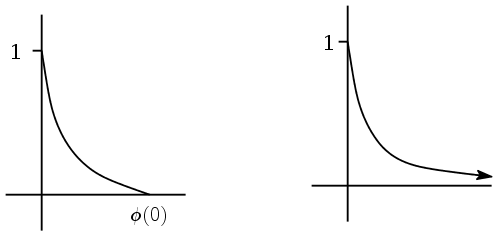
inverse φ[-1] : [0,∞)→[0,1]. The plots of the
inverses of the above two examples look like:
The exact definition is
φ[-1] (x) = φ-1 (x) if x ∈ [0,φ(0+))
              = 0           else
Then it is not difficult to see the following results:
φ[-1] is again continuous and convex. Also it is
decreasing (not necessarily strictly).
∀ x∈ (0,1] φ[-1] (φ(x)) = x.
∀ x∈ [0,∞) φ(φ[-1] (x)) = min{x,φ(0)}.
We shall prove this later. This motivates the following definition:
Note that if α>0 is any constant
and φ(·) is as above, then φ(·)
generate the same copula.
A sort of converse to the above theorem is also true, though of not much use in statistics:
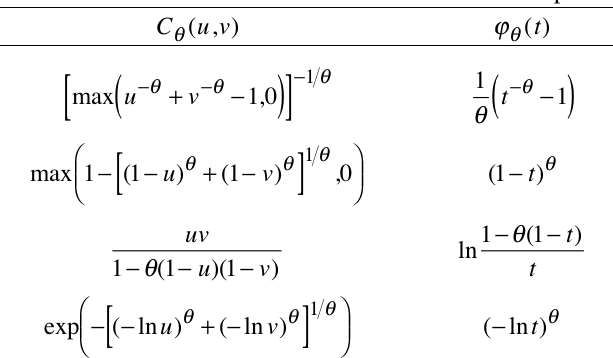
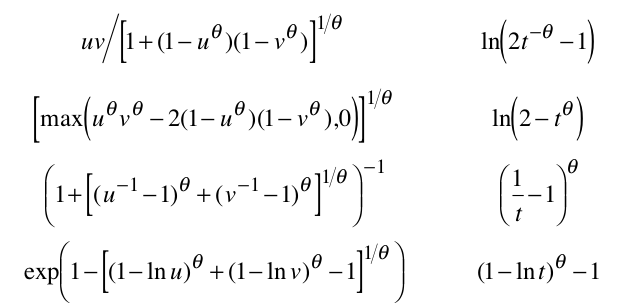
Choosing φ appropariately gives rise to many useful
Archimedean copula. Here are a few examples from the book by
Nelsen:
In univariate set up we are more interested in families of
distributions rather than individual distributions. Similarly, in
a multivariate set up, we are more
interested in families of Archimedean copulas than in single
Archimedean copulas. For this we choose
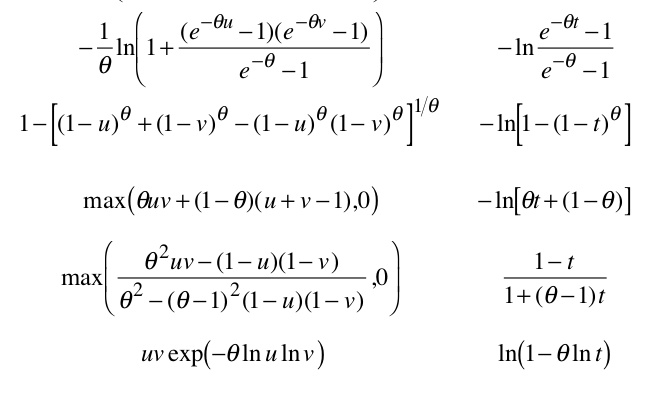
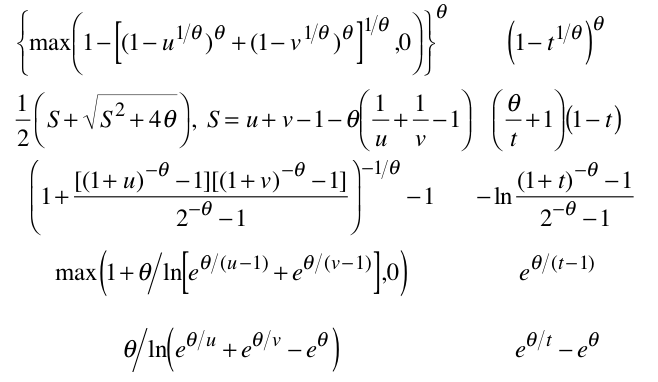
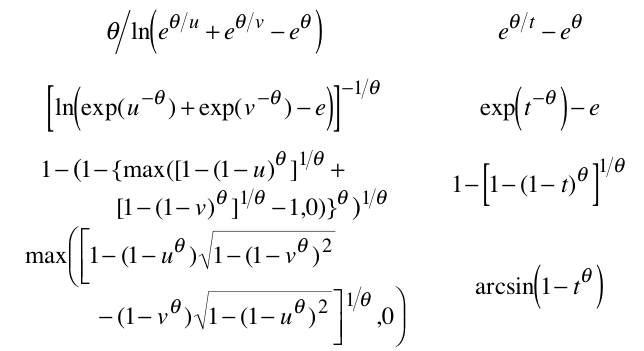
a φ with one or more parameters. The following list is
from Nelsen:
The approach to multivariate (or rather bivariate) modelling
using these families may be summarised as follows:
First we need to familiarise ourselves with the shapes of standard
univariate distributions, and standard bivariate copulas. We may
consider these as two libraries, one for marginals and one for
copulas.
Given a bivariate data set we should draw the marginal
histograms and pick suitable families of marginals from the library.
Also we should pick a family of copula from the other
library.
The chosen marginal families and copula family define a
family of bivariate distribution via Sklar's theorem.
We can now perform parametric inference with this family:
estimation, goodness-of-fit, testing etc.
Picking a suitable family of copulas is the trickiest step. We
shall later learn techniques to do so.
Some interesting properties of Archimedean copulas
A copula is a function C:[0,1]×[0,1]→[0,1], and
hence can be viewed as a binary operation on [0,1].
For an Archimedean copula, this binary operation has interesting
properties: it is commutative and associative. Also repeated
application of this binary operation on the some x∈
[0,1] results in a sequence
x, C(x,x), C(C(x,x),x), C(C(C(x,x),x),x), ...
If we denote the n-th entry in this sequence
by Cn (x) (slightly different notation than used in
class), then we have
Then it is easy to see the following theorem:
The similarity between this result and the Archimedean property
of IR has given rise to the name "Archimedean copula". The
theorem itself requires Archimedean property of IR for its proof.