We shall work with the field ${\mathbb C}.$ $A$ is
an $n\times n$ matrix.
$\v x\in{\mathbb C}^n$ is called an
eigenvector corresponding to an eigenvalue $\lambda\in{\mathbb C}$
if
$$
A\v x = \lambda \v x
$$
and $\v x\neq \v 0.$
The characteristic polynomial of $A$ is defined
as $p_A(\lambda)=det(A-\lambda I).$
$\lambda\in{\mathbb C}$ is an eigenvalue of $A$ if and
only if $p_A(\lambda)=0.$
If $\lambda\in{\mathbb C}$ is any eigenvalue of $A$ then
the eigenvectors corresponding to it are the nonzero vectors
in $\nul(A- \lambda I).$
The entire nullspace (including the zero vector) is called the
eigenspace corresponding to $\lambda.$
Two square matrices $A,B$ are called similar if $A = PBP
^{-1},$ for some nonsingular $P.$
Similarity is important because it is an equivalence. Two
matrices are similar if and only if they both represent the same
linear transformation (w.r.t. two different bases).
To understand this we need to understand the concept of
change-of-basis. Suppose that we have two bases $\B_1=\{\v
u_1,...,\v u_n\}$ and $\B_2=\{\v v_1,...,\v v_n\}$ for the
same vector space. Then any vector has two representations (one
w.r.t each of these bases). It will be useful to have a formula
by which we can move from one representation to the other.
Let $\v \alpha = (\alpha_1,...,\alpha_n)$ be the representation
w.r.t. $\B_1,$ and $\v \beta = (\beta_1,...,\beta_n)$
w.r.t. $\B_2.$
It should be clear that for each $\v \alpha $
we have unique $\v \beta.$ So this is a
function. Also, this is one-to-one and onto. Also it must be a linear transformation. Hence there must
exist a nonsingular matrix $P$ such that $\v\beta = P\v
\alpha.$ This $P$ is called the change-of-basis matrix
for moving from $\B_1$ to $\B_2.$ Clearly, if we want to
return to $\B_1$ from $\B_2,$ the change-of-basis matrix
will be $P ^{-1}.$
It is easy to see that the converse also holds: for any given
basis $\B_1$ and any nonsingular matrix $P,$ there
exists a basis $\B_2$ such that $P$ is the
change-of-basis matrix for moving from $\B_1$ to $\B_2.$
Now suppose we have a linear transformation $f:V\rightarrow V.$
Then w.r.t. $\B_1$ it will have a matrix
representation, $A,$ say. Also it will have a matrix
representation $B$ w.r.t. $\B_2.$
If $P$ is the change-of-basis matrix for moving
from $\B_1$ to $\B_2,$ then it is easy to
express $B$ in terms of $A$ and $P$ in three steps:
You start with a vector $\v v$ and its representation $\v \beta $
w.r.t. $\B_2.$ Convert it to the representation
w.r.t. $\B_1$ by $\v \alpha = P ^{-1} \v \beta.$
Now
apply $A$ to express $f(\v v)$ as $A\v \alpha = AP
^{-1} \v \beta $ in terms
of $\B_1.$
Finally return to $\B_2$ as $P A P ^{-1} \v \beta.$
Thus we see that $B=P A P ^{-1}.$
Again, the converse also holds: Given any basis $\B_1$ and
any pair of similar matrices $A,B$ there exists a
basis $\B_2$ such that the linear transformation represented
by $A$ w.r.t. $\B_1$ is the same as the linear
transformation represented by $B$ w.r.t. $\B_2.$
The proof is by induction on $k.$
Trivial for $k=1.$
Assume up to $k-1.$
To prove assume that $\alpha_1,...,\alpha_k\in{\mathbb C}$ are such
that
$$
\alpha_1\v v_1+\cdots +\alpha_k\v v_k = \v0.
$$
Premultiplying by $A$ we have
$$
\alpha_1 \lambda_1\v v_1+\cdots +\alpha_k \lambda_k\v v_k = \v0.
$$
Eliminate $\v v_1$ from these
two equations to get a linear combination of $\v v_2,...,\v
v_k$ only that equals $\v 0:$
$$
\alpha_2 (\lambda_2-\lambda_1)\v v_2+\cdots +\alpha_k (\lambda_k-\lambda_1)\v v_k = \v0.
$$
By induction hypothesis, the coefficients must all
vanish. So $\alpha_2=\cdots=\alpha_k=0,$
since $\lambda_i$'s are all distinct.
Hence $\alpha_1$ must be $0$ as well, since $\v
v_1\neq\v 0.$
If $\lambda\in{\mathbb C}$ is an eigenvalue of $A,$ then its
multiplicity as a zero of $p_A(\lambda)$ is called its
algebraic multiplicity (am). Also, the dimension of $\nul(A-
\lambda I)$ is called the geometric multiplicity (gm)
of $\lambda.$ Note that am or gm both must lie
between $1$ and $n.$ Also the sum of am's of all the
eigenvalues must be $n.$
The proof uses a standard trick. Start with any
eigenvalue $\lambda\in{\mathbb C}.$ Denote its gm by $g.$ Grab
any $g$ linearly independent eigenvectors $\v v_1,...,\v v_g$
Extend it to a basis $\{\v v_1,...,\v v_n\}$
of ${\mathbb C}^n.$ Stack these as columns to get a nonsingular
matrix $P.$
Note that $AP = PB,$ where $B$ is a block triangular
matrix, with leading block $\lambda I_g.$
Clearly $am(\lambda,B)\geq g.$ Also $am(\lambda,B) = am(\lambda,A).$
Hence the result.
The following result can be proved using the same trick.
The proof is by induction on $n,$ the size of the matrix.
Nothing to prove if $n=1.$
Assume up to $n-1.$
Shall prove for $n.$
Take any eigenvalue $\lambda\in{\mathbb C}.$ Pick any
eigenvector $\v v$ corresponding to it. Extend it to a
basis. Stack the basis vectors as columns to get a nonsingular
matrix $P.$ Then $AP = B P,$ where $B$ has the form
$$
B = \left[\begin{array}{ccccccccccc}\lambda & *\\ \v 0 & C
\end{array}\right],
$$
where $*$ denotes some row vector and $C$
is $(n-1)\times(n-1).$
Apply induction hypothesis on $C$ to write it as
$$
C = Q T Q ^{-1},
$$
where $T$ is upper triangular. Thus
$$
B = \left[\begin{array}{ccccccccccc}\lambda & *\\ \v 0 & QTQ ^{-1}
\end{array}\right] =
\left[\begin{array}{ccccccccccc}1 & \v 0'\\\v 0 & Q
\end{array}\right]\left[\begin{array}{ccccccccccc}\lambda &
*\\ \v 0 & QTQ ^{-1}
\end{array}\right] \left[\begin{array}{ccccccccccc}1 & \v 0'\\\v 0 & Q ^{-1}
\end{array}\right]
=\left[\begin{array}{ccccccccccc}1 & \v 0'\\\v 0 & Q
\end{array}\right]\left[\begin{array}{ccccccccccc}\lambda &
*\\ \v 0 & T
\end{array}\right] \left[\begin{array}{ccccccccccc}1 & \v 0'\\\v 0 & Q
\end{array}\right]
^{-1},
$$
completing the proof.
This result is very helpful to prove properties about square
matrices. If the property is invariant under similarity, then it
is enough to the prove it for upper triangular matrices only.
Here is one example.
If $am(\lambda,A)=gm(\lambda,A),$ then call $\lambda$ a
regular eigenvalue of $A.$
While similarity is a useful concept, performing a similarity
transformation is often numerically unstable if the
change-of-basis matrix is nearly singular.
So we often like to
work with the case where $P$ is unitary.
$A,B$ are said to be unitarily similar if $A = PBP^*$
for some unitary matrix $P.$
The following result (called Schur decomposition) is the unitary
analog of a result proved earlier. The proof is similar.
Unitary similarity with triangular matrices is a property shared
by all complex square matrices. Unitary similarity with diagonal
matrices, however, is more usefull to have. There is a simple
(though unexpected) characterization of such matrices.
We
need a little definition first.
Proof:
Thanks to Schur decomposition, it is enough to show the result
for only upper triangular matrices. Trivial direct computation
shows that an upper triangular matrix is normal if and only if it
is diagonal.
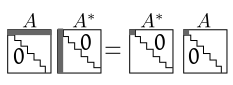
The following diagram tells you how to proceed with the
computation:
When we compute the $(1,1)$-th entry of $A A^*$ it is
$\sum|a_{1j}|^2.$ But when we compute the $(1,1)$-th
entry of $A^*A$ we get just $|a_{11}|^2.$ Equating
these we immediately get $a_{1j}=0$ for $j\geq 2.$
[QED]
Many useful types of matrices are normal. For example, real
symmetric and complex Hermitian.
Here a word is in order about the real symmetric case. Our main
weapon in proving the last theorem was Schur decomposition, which
is true for complex field, but not for real field. So what we get
is that every real symmetric matrix can be written
as $PDP^*,$ where $P$ is a (complex) unitary matrix,
and $D$ is a (complex) diagonal matrix. It would be nice
if $D$ and $P$ may also be guaranteed to have real
entries. Indeed, this is true:
The proof proceeds in two simple steps:
In the first step we show that all the eigenvalues of a real
symmetric matrix must be real. Let $\lambda $ be an
eigenvalue of a real symmetric $A.$ Let $\v v\in{\mathbb C}^n$
be any eigenvector for it. Just expand $\v v^* A\v v$ is two
ways:
$$
\v v^* A \v v = \v v^* \lambda \v v = \lambda \|\v v\|^2
$$
and
$$v v^* A \v v = (A\v v)^* \v v = \bar \lambda \v v^*\v v = \bar
\lambda \|\v v\|^2.
$$
Since $\v v\neq\v0,$ tyhis proves that $\lambda\in{\mathbb R}.$
In the second part we show that if $\v u$ and $\v v$ are
real eigenvectors corresponding to distinc eigenvalues, then $\v
u'\v v=0.$ It follows easily by expanding $\v u'A\v v$ in
two ways.
Since $A$ is normal, the gm's sum to $n.$
For each distinct eigenvalue, get an ONB of the
eigenspace. Together they form ONB of ${\mathbb R}^n.$
Stack these as columns to get an orthogonal matrix $P.$
Clearly, $AP = PD,$ or $A = PDP',$ as required.
The decompostion $A = PDP'$ is called spectral decomposition
of $A.$
Just as Schur decomposition allows us to replace any square
matrix by an upper triangular matrix while working with
properties invariant under similarity and
congruence, similarly spectral decomposition allows us to think
of real symmetric matrices as diagonal.
Think of a real diagonal matrix $D.$ It should be obvious
that $D$ is
PD $\Leftrightarrow$ all the diagonal entries are $>0.$
NND $\Leftrightarrow$ all the diagonal entries are $\geq0.$
So we immediately get the following result.
Of course, you can state analogous result for ND, NPD and ID matrices.
Here is another generalisation of diagonal matrices. The
following result is obvious.
Proof:
$\v x'D \v x = \sum d_i x_i^2 \in [m,M]\sum x_i^2=[m,M],$
since $\sum x_i^2=1.$
Also $\v x' D\v x - m = \sum (d_i-m) x_i^2.$ All the terms
in the sum are nonnegative, and so the sum vanishes iff all the
terms are individually zero. So for all $i$ we
need $(d_i-m) x_i^2=0.$ This happens iff $x_i=0$
whenever $d_i > m.$
The condition for the maximum follows similarly.
[QED]
This result easily generalises for real, symmetric matrices:
Proof:
Let $A = PDP'$ be a spectral decomposition. Then
$$\{\v x' A \v x~:~\|\v x\|=1\} = \{\v y' D \v y~:~\|\v y\|=1\}.$$
This is follows immediately on putting $\v y = P'\v x.$
So, by the last result, the minimum and maximum
is $\min\{\lambda_i\}$ and $\max\{\lambda_i\}.$
Also, the minimum is attained iff $y_i=0$
whenever $\lambda_i > m.$
Thus $\v x = P\v y$ is a linear combination of the
columns of $P$ corresponding to $m.$ Since these
columns form an ONB of the eigenspace for $m,$ the condition follows.
Similarly, for the other condition.
[QED]
By a principal submatrix of a square matrix, we understand a
(square) submatrix whose position in the original matrix is symmetric
around the leading diagonal. The determinant of such a submatrix
is called a principal minor. If the submatrix is positioned in
the top left corner of the original matrix, then we call it a
leading principal submatrix.
Proof:
The "if part" is trivial, since the entire matrix itself is a
leading principal submatrix.
For the "only if part" let $A_k$ be the $k$-th leading
principal submatrix of $A.$ Shall show that $A_k$ is
PD, ie,
$\forall \v x(\neq\v0)\in{\mathbb R}^k~~\v x' A_k \v x > 0.$
Take any $\v x\neq\v 0$ in ${\mathbb R}^k.$
Define $\v y\in{\mathbb R}^n$ as
$$
\v y = \left[\begin{array}{ccccccccccc}\v x\\\v 0_{n-k\times1}
\end{array}\right].
$$
Now
$$
\v x' A_k \v x =\v y' A\v y > 0,
$$
since $\v y\neq\v 0$ and $A$ is PD. This completes the proof.
[QED]
The following theorem is very important, as it gives a simple
characterisation of PD and NND matrices.
Proof:
If $A = B' B$ for some real matrix $B$ then clearly for
any $\v x$ we have $\v x' A\v x = \v x' B'B \v x = (B\v
x)'(B\v x) = \|B\v x\|^2\geq 0.$ Hence NND.
For the converse let $A$ be NND. So in particular $A$
is real symmetric. Let a spectral decomposition be $A =
PDP'.$ Then the diagonal entries of $D$ are the
eigenvalues and hence we can take their square roots to
get $D^{1/2}.$
So $A = PDP' = PD^{1/2}D^{1/2}P' = B'B,$ where $B = D^{1/2}P'.$
Proof of the PD part is similar.
[QED]
Here are a few facts that are simple to prove, and are often
useful.
Proof:
The result is true for any upper triangular matrix (since the
eigenvalues are the diagonal entries). So the result holds for
all square matrices over ${\mathbb C}$ using Schur decomposition.
[QED]
Proof:
Use Schur decomposition. Notice that if $A$ is similar to an
upper triangular matrix $T,$ then $p(A)$ must be
similar to $p(T),$ which is again upper triangular. Also,
$((p(T)))_{i i} = p(t_{i i}).$
[QED]
Proof:
The result is obvious for upper triangular matrices. Generalise
to general square matrices (over $cc$) by Schur decomposition.
[QED]
Proof:
Let $\lambda\neq0$ be an eigenvalue of $AB$ with a
corresponding eigenvector $\v v\neq\v0.$
Then $AB\v v = \lambda\v v,$ and so premultiplying
by $B,$ we get $BAB\v v = \lambda B\v v.$
From this we want to claim that $\lambda $ is an eigenvalue
of $BA$ corresponding to eigenvector $B\v v.$
To do this we need to check that $B\v v\neq\v 0,$ which is
obvious because if $B\v v=\v 0,$ then $AB\v v=\v 0,$
and hence $\lambda \v v = \v 0,$ which is impossible
since $\lambda\neq0$ and $\v v\neq\v 0.$
[QED]
The following theorem is a stronger version of teh above, which
also shows that the $am$'s must match for the nonzero
eigenvalues.
Proof:
The proof is not as straight forward as that of the last
theorem. Consider the two matrices
$$
C = \left[\begin{array}{ccccccccccc}\lambda I & A \\ B & I
\end{array}\right] \mbox{ and } D = \left[\begin{array}{ccccccccccc}-I &
O \\B & - \lambda I
\end{array}\right].
$$
Now compute $CD$ and $DC,$ and use the fact that $det(CD) = dec(C)\cdot\det(D) = det(DC).$
[QED]
This proof, by the way, is not at all intuitive. Don't feel
disheartened if you do not readily see how $C$ and $D$
were chosen. They were chosen by back calculation and
trial-and-error. The result is useful, not the technique used in
its proof.
It is a very useful generalisation of spectral decomposition of
real symmetric matrices. It applies to all matrices (need not
even be square) over ${\mathbb R}$ or ${\mathbb C}.$ We first state the
result over ${\mathbb R}:$
Proof:
First let's do a little rough work to guess how to
construct $U,V$ and $D.$ Assuming that such a
decomposition exists we have
$$
A'A = VD^2 V'.
$$
So clearly the columns of $V$ must be eigenvectors
of $A'A$ and the diagonal entries of $D^2$ must be the
eigenvalues. So we must take the positive square roots of the
nonzero eigen values of $A'A$ as the nonzero diagonal
entries of $D.$ Again, we have $AV = DU.$ This tells us
how to choose the first $r$ columns of $U.$
That's all the rough work we shall need. Now we shall
define $U,V,D$ following rough work, and directly prove that
$A = UDV'.$
Take a spectral decomposition of the real, symmetric
matrix $A'A:$
$$
A'A = V S V'.
$$
We shall use this $V.$ Also we know that $r(A) = r(A'A)=
r(S) = r.$ So exactly $r$ of the diagonal entries
of $S$ must be nonzero (actually positive). We
define $D$ as the $m\times n$ matrix all whose entries
are 0, except $d_{i i} = \sqrt{ s_{i i}}.$
Next, we define $\v u_i = \frac{1}{d_i} A\v v_i$ for $i=1,...,r.$
These must be orthonormal. (Check this by directly
computing $\v u_i'\v u_j$.)
Extend $\{\v u_1,...,\v u_r\}$ to an ONB of ${\mathbb R}^m:$
$$
\{\v u_1,...,\v u_m\}.
$$
Stack these a columns to get an orthogonal matrix $U.$
So we have finished constructing all the necessary
ingredients: $U,D$ and $V.$
Now it is trivial to check that $A = UDV'.$
This completes the proof.
[QED]
If the field is ${\mathbb C}$ then the SVD looks like $A =
UDV^*$, but the nonzero entries of $D$ are still positive
real numbers. In the proof we work with $A^*A$ in place
of $A'A.$
A rather surprising theorem is the following:
An example will help to illustrate what we mean by $p(A).$
Suppose
$$A= \left[\begin{array}{ccccccccccc}1&2\\3&4
\end{array}\right].$$
Then $p(x) = |A-x I| = (1-x)(4-x)-6 = x^2-5x-2.$
Then $p(A) = A^2-5A-2I = \cdots = O.$ Notice how the
constant term $-2$ in $p(x)$ was converted
to $-2I$ in $p(A).$
Proof:
The proof relies on the standard fact that for any square matrix $B$
we have
$$
B\cdot adj(B) = |B|\cdot I,
$$
where $adj(B)$ is th adjugate of $B.$ It is the matrix
of cofactors of $B.$ For example, the $(i,j)$-th entry
of $adj(B)$ is the $(-1)^{i+j}$ times the determinant
of the submatrix of $B$ obtained by deleting the $j$-th
row and $i$-th column (note the switch between row and
column).
We shall apply this result with $A-xI$ in place of $B$
to get
$$
(A-xI)\cdot adj(A-xI) = p(x) I.
$$
Let's understand $adj(A-xI)$ taking the example $A= \left[\begin{array}{ccccccccccc}1&2\\3&4
\end{array}\right].$
Here $A-xI = \left[\begin{array}{ccccccccccc}1-x&2\\3&4-x
\end{array}\right],$ and so $adj(A-xI)
= \left[\begin{array}{ccccccccccc}4-x & -2\\ -3 & 1-x
\end{array}\right].$
Notice that each entry is a polynomial of degree at
most $1.$ Convince yourself that for a general $n\times
n$ matrix $A,$ each entry of $adj(A-xI)$ will be a
polynomial of degree at mot $n-1.$
The next step is to rewrite $adj(A-xI)$ as a polynomial
in $x$ with matrix coefficients. Again our example will help.
$$
adj(A-xI)
= \left[\begin{array}{ccccccccccc}4-x & -2\\ -3 & 1-x
\end{array}\right] =
\left[\begin{array}{ccccccccccc}4 & -2\\ -3 &1
\end{array}\right] + \left[\begin{array}{ccccccccccc}-1 & 0\\ 0& -1
\end{array}\right]x.
$$
For general $A_{n\times n}$ this will be
an $n-1$-degree polynomial, which we shall write as
$$
adj(A-xI) = C_0+C_1x+\cdots+C_{n-1} x^{n-1}.
$$
Here each $C_i$ is an $n\times n$ matrix.
Now we are in a position to use our result:
$$
(A-xI)\cdot adj(A-xI) = p(x) I,
$$
which can be written as
$$
(A-xI)(C_0+C_1x+\cdots+C_{n-1} x^{n-1}) = p(x)I.
$$
If we write $p(x) = p_0+p_1x+\cdots+p_n x^n,$ then this
becomes
$$
AC_0 +(AC_1-C_0)x+(AC_2-C_1)x^2+\cdots+(AC_{n-1}-C_{n-2})x^{n-1}
- C_{n-1}x^n = p_0I+p_1Ix+\cdots +p_n Ix^n.
$$
Note that this holds for all $x,$ ie, we have an identity. So we can match
coefficients. Don't worry about the coefficients being matrices,
just think that you are matching scalar coefficients for a single identity for each entry.
Then you get
$$
AC_0 = p_0I,~~ AC_1-C_0 = p_1I,~~ \ldots,~~AC_{n-1}-C_{n-2} = p_{n-1}I,~~-C_{n-1} = p_nI.
$$
It immediately follows that $p(A) = p_0I+p_1A+p_2A^2+\cdots +p_n A^n = O.$
[QED]
Prove that every idempotent matrix is similar to a diagonal
matrix with diagonal entires $0$ or $1.$
Prove that a matrix denotes an orthogonal projection
(over ${\mathbb R}$ w.r.t. Euclidean inner product) iff it
is of the form $PDP',$ where $P$ is an orthogonal
matrix and $D$ is a diagonal matrix with diagonal
entries $0$ and $1.$
Show that if $A^2=A$ then $r(A)=trace(A).$ Is the
converse true? Justify your answer.
A diagonal matrix has eigenvalues equal to the diagonal
entries. Gershghorin's theorem says that if a matrix is
approximately diagonal (ie, off-diagonals may be nonzero, but
have small magnitude), then the eigenvalues cannot be far from
the diagonal entries. More precisely, prove the following.
Let $A$ be a square matrix and $R_i = \sum_{j\neq i}
|a_{ij}|.$ If $\lambda$ is an eigenvalue of $A$ then
it must lie in the union of the discs
$$
D_i = \{z\in{\mathbb C}~:~ |z-a_{ii}| \leq R_i\}.
$$
Show that if $A_{2\times2}$ has
eigenvalues $\lambda_1\neq \lambda_2,$ then the columns
of $A- \lambda_1 I$ must be eigenvectors (or $\v 0$)
corresponding to $\lambda_2.$
A permutation matrix is a matrix that has exactly
one $1$ in each row and column (the rest
being $0$). It is called a permutation matrix because
pre(or post)multiplying by it causes the rows(or columns) of a
matrix to be permuted. Can you find at least one eigenvalue and
eigenvector for a permutation matrix?
We know that the characteristic polynomial $det(A- \lambda
I)$ of an $n\times
n$ matrix $A$ is a polynomial with degree $n$ and
coefficient of $\lambda^n$ equal to $(-1)^n.$ Is it
true that any such polynomial must be the characteristic
polynomial of some matrix? If we allow complex matrices, then it
is easy to see that the answer is "Yes". Just find all the roots,
and create a diagonal matrix with them. But if the polynomial has
real coeeficients, then is it possible to have a real
matrix with that polynomial as its characteristic polynomial? Explore this by choosing suitable
numbers in place of the * below:
$$
A = \left[\begin{array}{ccccccccccc}
0 & 1 & 0\\
0 & 0 & 1\\
0 & 0 & *
\end{array}\right]
$$
to make the characteristic polynomial $-\lambda^3,$ $3
\lambda^2 - \lambda^3$ and $2 \lambda^2 - \lambda^3.$
Next make the characteristic polynomial $2 \lambda -
\lambda^3.$ by choosing a suitable
number in place of the * below:
$$
A = \left[\begin{array}{ccccccccccc}
0 & 1 & 0\\
0 & 0 & 1\\
0 & * & 0
\end{array}\right]
$$
Prove that all $n$-degree polynomials with leading
coefficient $(-1)^n$ is the characteristic polynomial of
some $n\times n$ matrix of the form
$$
\left[\begin{array}{ccccccccccc}
\v 0 & I_{n-1}\\
\v a' & b
\end{array}\right].
$$
Let
$A_{n\times n}$ is a real, symmetric, nonsingular matrix with
eigenvalues $\lambda_1 > \lambda_2 > \cdots > \lambda_n>0.$
Let $\v x_0\in{\mathbb R}^n$ be any unit vector. We define a sequence of vectors as
follows.
$$
\v x_{k+1} = unit(A\v x_k),
$$
where $unit(\v p)$ denotes the unit vector along $\v p.$ What can you say
about the limit?
Hint:
Let $\v v_i$ be a unit norm eigenvector corresponding
to $\lambda_i.$ Then we know that $\{\v v_1,...,\v
v_n\}$ is an ONB of ${\mathbb R}^n.$
Observe that $\v x_k$ is a multiple of $A^k\v x_0$ and
also has unit norm. So
$$
\v x_k = \frac{A^k\v x_0}{\|A^k\v x_0\|}.
$$
Let $\v x_0 = \sum\alpha_i \v v_i.$
Then
$$
A^k\v x_0 = \sum \alpha_i \lambda_i^k \v v_i,
$$
and hence
$$
\|A^k\v x_0\|^2 = \sum \alpha_i^2 \lambda_i^{2k}.
$$
Let $i_*$ be the minimum value of $i$ for which $\alpha_i\neq 0.$
Now complete the solution.
Let $A$ be a stochastic matrix (ie, whose row sums are
all $1$, and entries are all $\geq0$). Show that $1$ must be an eigenvalue
of $A.$ Also show that if $\lambda\in{\mathbb C}$ is any
eigenvalue then $|\lambda|\leq 1.$
Let $A_{5\times5}$ have $am(1,A)=5.$ What is the
minimum possible value for $gm(1,A)?$ Construct one
such $A$ with this minimum value.
A matrix is such that all its eigenvalues have $am=1.$
Must it be semisimple?
State true/false: A square matrix is nonsingular iff all its
eigenvalues are nonzero.
State true/false: The rank of a square matrix equals the
number of nonzero eigenvalues (each counted according to
its $am$).
State true/false: The rank of a square matrix equals the
number of nonzero eigenvalues (each counted according to
its $gm$).
Construct a matrix that is similar to a diagonal matrix but
not unitarily similar.
Prove: Two diagonal matrices are similar iff their diagonal entries
are just permutations of each other.
Prove: For any real square matrix $A,$ the
matrices $A'A$ and $A A'$ are similar.
True/False: If $A$ is unitarily diagonalisable
and $B$ is similar to $A,$ then $B$ must also be
unitarily diagonalisable.
Show that the sum of NND (or PD) matrices is again NND (or PD).
For any NND matrix $A$, show that there is an NND
matrix $B$ such that $A = B^2.$
If a matrix is NND, then show that all its principal
submatrices (ie, submatrices symmetric around the leading
diagonal) are also NND.
Show that a PD matrix has positive determinant and
trace.
Show that a PD matrix has all leading principal
minors $>0.$ The converse is also true. But we shall not
prove it here.
If $A,B$ are two complex matrices such
that $AB-BA$ has rank $1,$ then show that $(AB-BA)^2=O.$
Let $A$ and $B$ be $n\times n$ matrices
where $|A|\neq0.$ Show that there are at most $n$
distinct values of $\beta $ such that $A+ \beta B$ is
singular.
Let $A$ and $C=C_1+C_2$ be matrices such
that $AC_1=C_2A=O.$ Show that for every matrix $B$ the
characteristic polynomials of $AB$ and $A(B+C)$
are equal.
Consider the permutation matrix $A=((a_{ij})),$
where $a_{i,i+1}=1$ for $i=1,...,n-1$
and $a_{n1}=1.$ All the other $a_{ij}$'s are $0.$
Show that the eigenvalues of $A$ are the $n$-th roots
of unity.
A matrix $A$ is called nilpotent
if $A^k=O$ for some $k\in{\mathbb N}.$ Show that a complex
matrix is nilpotent iff all its eigenvalues are $0.$
A matrix $A$ is such that all nonzero vectors are its
eigenvectors. If $a_{11}=5,$ then find $A.$
A complex matrix $A_{n\times n}$ is such that for all
subspaces $S\leq {\mathbb C}^n$ we have $\forall \v x\in S~~A\v
x\in S.$
Show that $A = \alpha I$ for some scalar $\alpha.$
A complex matrix $A$ commutes with all idempotent
matrices (ie, if $B$ is any idempotent matrix,
then $AB=BA$). What can you say about $A?$
If $\v x,\v y\in{\mathbb R}^n,$ then find the eigenvalues
(along with am's and gm's) of $A_{n\times n}=\v x \v
y'.$
Let $A$ be a square matrix. A polynomial $f(x)$ is
called an annihilating polynomial for $A$ if $f(A)=O.$
Thus, Cayley-Hamilton Theorem says that characteristic polynomial
is always an annihilating polynomial.
Also $p(x)$ is called a minimal polynomial
for $A$ if it is annihilating and
monic (ie, leading coefficient is $1$) and has the least
possible degree among all annihilating polynomials.
Show that a minimal polynomial always divides any annihilating
polynomial. Hence conclude that minimal polynomial for a matrix
must be unique.
Show that similar matrices have the same minimal polynomial.
If $\lambda\in{\mathbb C}$ is an eigenvalue of $A$ then
show that $p(\lambda)=0.$
If $p(\lambda)=0$ for some $\lambda\in{\mathbb C}$ then
show that $\lambda $ must be an eigenvalue of $A.$
$A$ is semisimple iff all the roots of its minimal
polynomial are distinct.
Hint:
Showing "Semisimple $\Rightarrow$ distinct roots" is
easy.
For the converse, let the minimal polynomial be
$$
m(\lambda) = (\lambda-\lambda_1)\cdots(\lambda-\lambda_k),
$$
where all the $\lambda_i$'s are distinct. We need to show
that ${\mathbb C}^n$ is the sum of all the eigenspaces, ie, $\nul(A-\lambda_i I).$
Define
$m_i(\lambda) = m(\lambda)/(\lambda-\lambda_i),$ ie, product
of all $(\lambda-\lambda_j)$'s except for $j=i.$ Note
that
$$
p(\lambda) = \frac{m_1(\lambda)}{m_1(\lambda_1)} + \cdots + \frac{m_k(\lambda)}{m_1(\lambda_k)}
$$
is actually identically equal to $1,$ (since it is $1$
for $\lambda=\lambda_1,...,\lambda_k$ and has degree $\leq
k-1$).
So $p(A) = I,$ and hence for all $\v x$ we have
$$
\v x = \frac{m_1(A)\v x}{m_1(\lambda_1)} + \cdots + \frac{m_k(A)\v x}{m_1(\lambda_k)}
$$
The proof will be complete once you show $m_i(A)\v x\in \nul(A-\lambda_i A).$
If $A,B$ are square matrices of the same size, then
show that $I+AB-BA$ cannot be nilpotent.
Show that for any $n\times n$ matrix $A$ we can
express $A^n$ as a linear combination
of $I,A,...,A^{n-1}.$ Conclude that any $A^k$
($k\in{\mathbb N}$) is in $span\{I,A,...,A^{n-1}\}.$
If $\left[\begin{array}{ccccccccccc}A & B\\B' & D
\end{array}\right]$ is NND where $A$ is
square, then show that $\col(B)\leq \col(A)$ and $\row(B)\leq \row(D).$
Show that the inverse of a PD matrix is PD.
If $A = \left[\begin{array}{ccccccccccc}P & Q\\Q' & S
\end{array}\right]$ is a PD matrix, then
show that $P-QS ^{-1} Q'$ is PD too.
Show that for a real symmetric matrix $A,$ which is not
ND, the following
quantities are all equal to the largest eigenvalue:
Let $A$ be a real, symmetric matrix with
eigenvalues $\lambda_1\geq \cdots\geq \lambda_n,$ and
corresponding eigenvectors $\v v_1,...,\v v_n.$ Then for
each $k=0,...,n-1$ the maximum possible value of $\v x'A\
\v x$ subject to
$\|\v x\| = 1$
$\v x\perp\{\v v_1,...,\v v_{k-1}\}$
is $\lambda_k,$ and this maximum is attained iff $\v x$
is an eigenvector corresponding to $\lambda_k.$ Note that
for $k=0$ this reduces to a theorem we have already seen above.
For a real square matrix $A$ define $\sigma(A)$ as
the largest singular value of $A.$ Show
the following:
$\sigma(A)=0$ if and only if $A=O.$
For any $\alpha\in{\mathbb R}$ we have $\sigma(\alpha A) = |\alpha| \cdot \sigma(A).$
For any two real square matrices $A,B$ we have $\sigma(A+B)\leq \sigma(A)+\sigma(B).$
Thus $\sigma(\cdot)$ is a norm on the space of square
matrices. It is called the spectral norm.
Show that for any real matrix $A_{m\times n}$ with
singular values $\sigma_1,...,\sigma_r$ we
have $\sum_{i,j} a_{ij}^2 = \sum_i \sigma_i^2.$ The square
root of the LHS is
called the Frobenius norm of $A.$
If $A,B$ are square matrices of the same size, then we
shall say $A\geq B$ to mean $A-B$ is NND. Prove the
following.
$A\geq B$ and $B\geq
A$ $\Rightarrow$ $A=B$
$A\geq B$ and $B\geq C\Rightarrow A\geq C.$
If $A,B$ are both NND and $A\geq B$ then $|A|\geq |B|.$
If $A,B$ are both PD, and $A\geq B$
and $|A|=|B|,$ then $A=B.$
Let $A$ be PD. Then show that $A-\v b\v b'$ is PD
iff $\v b'A ^{-1} \v b < 1.$
If $B$ is an $m\times n$ matrix with $m < n.$
Show that there exists $C_{(n-m)\times n}$ such
that $\left[\begin{array}{ccccccccccc}B\\C
\end{array}\right]$ is PD iff the submatrix of $B$
formed by the first $m$ columns is PD.
A square matrix $A$ is called strictly diagonally
dominant if $\forall i~~|a_{i i}| > \sum_{j\neq i}
|a_{ij}|.$ Show that if $A$ is such a symmetric matrix with
positie diagonal entries, then $A$ must be PD. Is the
converse true?
If $A,B$ are both NND, then show that all the
eigenvalues of $AB$ are nonnegative.
Let $A$ be a real symmetric matrix. Show that the set $\{\v x~:~\v x' A\v x\leq 1\}$ is
bounded iff $A$ is PD.
Show that for all real symmetric matrix $A,$ there
exists $\alpha\in{\mathbb R}$ such that $A+ \alpha I$ is
PD.
Show that every real symmetric matrix can be written
as $A-B$ where $A,B$ are two suitable NND matrices.
Find all values of $x\in{\mathbb R}$ such that the set
$$
\{(x,1,...,1),~(1,x,1,...,1),...,(1,1,...,x)\}
$$
is not a basis of ${\mathbb R}^n.$
Show that for any real symmetric matrix $A\neq O$ we
have $tr(A^2)> 0$ and
$$
r(A) \geq \frac{(tr(A))^2}{tr(A^2)}.
$$